


When it takes too long to roll the blunt

I think pot should be legal. I don’t smoke it, but I like the smell of it. Andy Warhol

Marijuana has been recreationally legalized in four states making it easy for tourists to try out the state’s finest. Tourists with an enthusiasm for weed will now have four states to choose from with several weed-related tourist attractions. From weed-friendly hotels to white water rafting with complimentary weed, there are now many ways to make the best of your 420 vacation.
Here we’ll go over some of the marijuana-related activities that you can only get away with in one of the four states with recreational marijuana.
Oregon
In Oregon smoking marijuana is legal, but only on private property when permitted. This can be troublesome as a tourist as you may not ever be on private property where you’re allowed to smoke. Not to worry, Weed Country Adventures has got you covered. WCA is a whitewater rafting company that also smokes you up. They get away with this by making stops on private properties to get you legally high. If you’re a fan of both marijuana and whitewater rafting the WCA was literally made for people like you.
Colorado
Marijuana friendly lodging is easy to come across in Colorado, recreational marijuana is even easier to come across. There are marijuana tour buses with dab rig and e-nail stations on board. Loopr is one of the most popular marijuana party buses in the state:
“Hang out, relax and enjoy the biggest, baddest party bus in Colorado with comfortable seating for 46, a glassware and dab bar, granite countertops on the 4 booths, more than a dozen video monitors for multimedia entertainment and route information, free WiFi, a lavatory and refrigerator, laser light show and more!!”
While in Colorado you can take marijuana cooking classes or get a marijuana-infused massage. Colorado is definitely one of the spots with the most options when it comes to weed and weed-related activities for tourists.
Washington
One dope marijuana-related activity you can try in Washington is the Cannabus. The Cannabus is a weed party bus that takes you to grows and dispensaries in Washington. You can also get baked on board! Washington’s main attractions to pot loving tourists would be their recreational shops. Smoking in public is forbidden and there are less shops and weed related events going on in Washington than in Colorado or Oregon. If pot is a main theme in your vacation Washington may be a little too conservative for your tastes. Marijuana is treated like alcohol so you can’t be seen smoking in public or you’ll face consequences. Fortunately, those consequences are only a $27 dollar fine so at least you can smoke without fear of jail time.
Alaska
The scenery in Alaska is quite a sight for red eyes. Who doesn’t want to see the Northern Lights while high on Northern Lights? Alaskan Thunder Fuck would be another good strain to try on your trip to Alaska. You might even get some for free. The laws in Alaska allow adults to legally gift each other marijuana. So the best way to get some weed while in Alaska is to ask somebody “Hey, can I have some of your weed?” Business’ like bud and breakfasts will straight up give you free weed as an incentive to stay with them over competitors.
image credit: Bigstock

We all love to get together with our friends and pass around the cannabis, right? It promotes bonding, stimulates conversation, and it just makes everything better – food, music, movies, you name it.
But just like any other social activity, there’s etiquette to be observed; unspoken rules that must be followed so that everyone can enjoy the smoking session to the fullest. These are bound to vary from group to group and place to place, but I’ve put together what I think are the most universal cannabis “no-nos.”
Here is what NOT to do when getting high with your friends:
If I had a nickel for every time my lighter went missing during a smoking session, I’d have shit load of nickels.
I get it. You’re stoned, zoned out, not paying attention, and there’s several different lighters being passed around… it’s easy to pocket someone else’s. (I’ve probably done it myself.) But it’s a definite buzz kill when you go to light up later on, and find that your trusty flame has disappeared.
So be aware, and make sure that lighter in your pocket is your own.
When sharing a bowl with your friends, don’t hold your lighter over it until the whole thing is ablaze. It burns up the weed too fast, and the next person in line is gonna taste nothing but burnt herb. Just a touch of flame is all you need to get one edge burning. Save some green for the next guy – it’s common courtesy.
Let’s face it: nobody likes a mooch. We all know that guy who always wants to come over and smoke, even though he’s never got any weed of his own. Not cool. So whenever you get your hands on some good cannabis, remember your friends who smoked you up when you had none. Call ’em up, and return the favor.
Don’t you hate it when you’re smoking with your friends, someone passes you the joint, and the end is all soaked in spit? It’s hard to hit because the tip keeps sealing closed. Not mention it’s just gross. Don’t drool on the joint. Just don’t.
This goes for pipes and other smoking accessories, too. No one wants someone else’s slobber on their glassware.
You know that guy who gets so caught up in the story that he’s telling that he forgets to pass the joint? And by the time he realizes it, the damn thing has gone out. So annoying!
But I have a confession to make: I am that guy. I’m sorry. I know it sucks, and I’m working on it. Really, I am. Don’t be like me. When it’s your turn, shut up and hit it. Pass it on, then you can finish your story. Okay?
This is similar to holding the joint too long, only it’s less about being absent-minded and more about being a selfish, weed hogging jerk. You know the rule: “Puff, puff, pass.” Two puffs. Count ’em! Don’t try to sneak in a dozen hits every time it’s your turn. We see what you’re doing, and it’s not cool.
Just because cannabis is being decriminalized across the country, doesn’t mean you can get high whenever, wherever you want. Alcohol is legal, too. Getting drunk in the parking lot… not so much. Same goes with smoking and driving – don’t do it. Come on, we’re not in high school anymore. Smoke responsibly. Smoke at home.
And speaking of high school, remember making your own pipe out of a Pepsi can? Or a bong from a 2 liter bottle? Cutting a screen out of an old, rusty window screen? Yeah… it turns out that’s not such a good idea.
Aluminum, plastic, and other DIY materials can release toxic chemicals when exposed to high heat. So, you end up inhaling a lot more than just cannabis – and possibly doing real harm to your throat and lungs. So, unless you happen to be a professional glass blower, don’t make your own pipes. It’s just not worth it. Save up for a real piece. And in the meantime, go get some papers, and roll it up!
What did I miss? What are your weed smoking pet peeves? Tell us about it in the comments below!
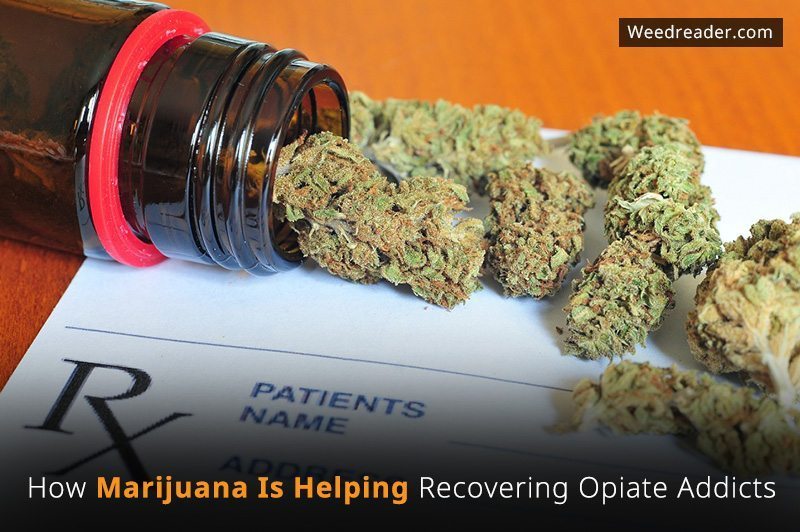
Opioid abuse has been on the rise in the United States for a long time. Since 1999 opioid abuse has more than quadrupled. The opioid problem has gotten so bad that the Center for Disease Control and Prevention issued a guideline urging doctors to be more cautious with the number of opioid prescriptions they give out. You wouldn’t expect to treat a drug addict with another drug but science has recognized cannabis as a reducer of withdrawal symptoms. Even though marijuana has received a stigma over the last century, the negative side effects of addictive prescription medications have hardly been mentioned. Now marijuana’s coming to the rescue after being shunned, much like batman.
The number of prescription opioids being produced in the U.S. went from 76 million to 207 million in two decades. The number of opioid drug overdose deaths reached a record high in 2014.
During recent clinical studies, medical cannabis was found to treat chronic pain. This means medical marijuana could take the place of more addictive opiate painkillers. This will result in less patients becoming hooked on painkillers. Painkillers often come with much more harmful side effects than those associated with medical marijuana.
How about for people already addicted to opiates?
Cannabis therapy is a thing and there is research in favor of its ability to kick opiate addiction. A study conducted by Lydie J Morel and others at the Laboratory for Physiopathology of Diseases of the Central Nervous System illustrated the potential of cannabis therapy to relieve dependence on morphine.
According to Dr. Sean Breen at Medical Cannabis of Southern California, a patient was able to overcome his strong opiate withdrawal symptoms by using cannabis therapy:
“Today was his last day of using subutex and he plans on using cannabis to manage any withdrawal symptoms that he experiences after finally stopping all opiate medications! Amazingly the effects of cannabinoids can reduce or eliminate the majority of symptoms of opiate withdrawal. Cannabis can reduce anxiety and agitation, improve sleep and helps normalize the digestive tract.”
A fully recovered heroin addict recalls how marijuana helped him overcome his heroin and methadone addiction:
“The marijuana helped me to sleep and eat and provided strength to continue detoxification. With the help of marijuana, I weaned myself off methadone in about four months. To this day I have continued to smoke marijuana, about three cigarettes per day and have never felt the desire to return to either heroin or methadone. My conclusion, based on this experience, is that marijuana is a potent medicine in the treatment of withdrawal from both heroin and methadone.”
Opioid addiction is already being treated with medical marijuana in Massachusetts
After a statewide epidemic of opioid deaths, cannabis doctors like Dr. Gary Witman of Canna Care Docs began prescribing marijuana to people to get them off of opioids. Witman alone has treated about 80 patients who were addicted to opioids, anti-anxiety medications or muscle relaxers.
In Conclusion
The promise of marijuana’s ability to help recovering opioid addicts is out there but it remains federally illegal. The DEA continues to ignore the science and case studies already out there on the medicinal benefits of marijuana. This has left marijuana listed among the most dangerous drugs.

New methods of cannabis consumption are arising every day. Smoking used to be the only method, but now you can vaporize, eat, or apply marijuana to your skin with cannabis topical. Cannabis-infused topicals are one of the newest modes of consumption. Topicals are cannabis-infused lotions, balms, or oils that can be absorbed through the skin for relief of pain and inflammation. Cannabis topicals can be used for several purposes.
Can Cannabis Topicals get you high?
Topicals can provide patients with the medicinal benefits of marijuana without the traditional high because they are not psychoactive. Cannabis topicals provide patients with the therapeutic benefits of marijuana without the cerebral high that usually follows a marijuana high. The amount of THC in topicals is usually so low, no type of high is felt after applying cannabis topicals.
Even if a topical has active THC in it, the high that usually follows marijuana smoking will not occur. Most topicals penetrate a system of CB2 receptors which aids in pain relief. Topicals reach the CB2 receptors in the skin and they cannot reach the blood stream. If a transdermal patch with cannabinoids is applied, the cannabinoids can reach the bloodstream and have psychoactive effects, if the THC content is high enough.
Pain Management
The most popular use of marijuana-infused topicals is the relief of localized pain, tension, and inflammation. The cannabinoids in topicals have painkilling properties. One example of how topicals combat pain is provided by Cannabis Basics’ CEO Ah Warner:
“Arthritic pain is caused by inflammation. My products have [THCA] and CBD, both of which are anti-inflammatory. Active THC is not for inflammation, but when left in its acid form and combined with CBD, the two work to get rid of inflammation and the pain that comes with it.”
So by combatting inflammation cannabis topicals are stopping the main cause of pain in sufferers of arthritis.
Sexual Pleasure Enhancer
Dr. Jennifer Berman, M.D., a prominent sexual-health advocate and clinician in Los Angeles, prescribes both Foria products to patients regularly-and is, in fact, such a fan of the line that she recently discussed it on Conan. “Perimenopausal, menopausal, and post-menopausal women who have noticed a decline in response have had great success with it,” she says. “Younger patients who have difficulty achieving orgasms have had enhanced response with it as well.”
Eczema Treatment
Cannabis topicals can also be used to treat various skin disorders including dermatitis and eczema. Cannabis oils should ease some of the itching and dryness that eczema sufferers experience. Users reported improvement from their skin disorders after applying marijuana-infused topicals.
In Conclusion
Marijuana topicals have several uses and all of them are medicinal. These topicals can only be obtained in certain states with medical marijuana laws. They don’t get you high but they can help with pain, skin disorders, cuts, burns, and even enhance orgasms. So whether you’re looking to improve your bedroom game or relieve some pain, you may be in the market for some cannabis-infused topicals. These topicals can be acquired at dispensaries where medical marijuana is legal or they can be made at home.
image: leafly

GSC or Girl Scout Cookie is one of THE most popular strains in the US, and growers have created strains like Thin Mint and Platinum Cookie (keeping in line with the theme) off the back of GSC’s popularity and fabled buds. The grow period is quick and the average yield per plant is anywhere between 25 and 30 grams, so expect to find this strain housed in dispensaries across the country. Because it’s won numerous Cannabis Cup awards, expect quality, reliability, and a high you can count on sticking around. Effects are reported to begin within 10 minutes, with mild tingling, laughing, and smiling.
Medical patients favor GSC for its pain relieving capabilities, from moderate to severe, and because it often helps with nausea and loss of appetite. Cancer patients going through chemo or suffering from no appetite may try Girl Scout Cookies and be amazed at how it might help. Many users report intense food cravings, or the “munchies”, and people with eating disorders often find relief using GSC to gain an appetite and actually enjoy food.
The taste profile is sweet, with some reports of chocolate, coffee, or vanilla, and often matched in flavor. Others have smelled and tasted mango, cookie batter, or citrus. The nuggets are small, dense, and look a little like OG Kush–orange hairs, long leaves. No surprise there, as GSC comes from a blend of OGK and the sativa strain Durban Poison. Regardless of which flavors you encounter, GSC is definitely a hybrid treat you’ll need to hit up a dispensary to try (please no harassing any little girls in Girl Scout uniform–they won’t have these cookies).
Feelings of stress disappear and are replaced with euphoria, a gentle sleepiness, and a pleasant full-body buzz in the muscles that creeps in and lasts long. Hardly any reports of paranoia or anxiety with this strain, and it’s enjoyed both indoors on the couch or outdoors in the sunshine. Not as great for multi-tasking stoners, Girl Scout Cookie provides head highs with a boost in spirits, so plan for a goofy adventure or just chilling out with some friends. Expect the giggles, feelings of happiness, and relief from anxiety, stress, and potentially migraines for those that suffer.
Chemical Makeup
THC: 17-28%
CBD: 0.09-0.2%
CBN: 0-0.5%
CBG: 0.4-2.2%
THCV: 0-0.6%
CBC: 0-0.7%
CBL: 0-0.4%
β-Linalool: 0.09-0.3%
β-Myrcene: 0-0.5%
a-Pinene: 0-0.3%
D-Limonene: 0.08-0.5%
β-Caryophyllene: 0-0.9%
image: leafly

Scented like pine and lemon with fuzzy, orange hairs and dark green leaves, OG Kush is another top favorite hybrid strain. With a THC content as high as 31%, this strain provides many users with relief from migraines, ADHD symptoms, and stress and insomnia. Fantastic for first-time users looking to start big. The effects are an intense relaxation, euphoria, and an increase in the munchies. This makes it popular for those with a lack of appetite, needing a way to relax and eat what they need. OG Kush is good to the last drop, right down to the crystals found studded on every nugget.
Variations of the phenotype include Tahoe OG and Alpha OG, with parentage of Chemdawg (seemingly the father of most cannabis strains) and Hindu Kush. OG Kush grows best outdoors, and is especially earthy, woodsy, and a true original grown in the right conditions. The strain has bred hybrids, knock-offs, and variations alike, but you’ll know when you get your hands on the ‘OG’ OG. The scent when smoked is often lemony, hazy, and the feeling overall reaps the benefit of both sativa and indica, depending on which is more dominant in the crop.
OG Kush buds are some of the most easily recognizable, with long, sticky leaves and those little orange hairs. Some crops yield buds with purplish or brownish tint, while others are dense, coated in kief crystals, and moist as all get out. Unless left to dry out, OG Kush stays on the stem, so not much shake towards the end. Nugs break apart more easily in a grinder, but pulling apart each leaf and savoring in the beauty could add whole new dimensions to your cannabis experience.
There are a few potentially negative affects, such as dry mouth and dry eyes, increase in paranoia, and possible dizziness. Take it slow, and you might feel more benefits like increased appetite, lower stress, and pain relief. Other reports say it brings on the giggles, light-headed relaxation, and some claim relief from symptoms of PTSD. Try smoking a joint of OG Kush before bed, if you have trouble sleeping or suffer from depression and insomnia. Be warned of variations leaning harder on the indica genes, as they’ll cause a deeper body high, so avoid this strain if you need to be active or want to keep alert.
Chemical makeup
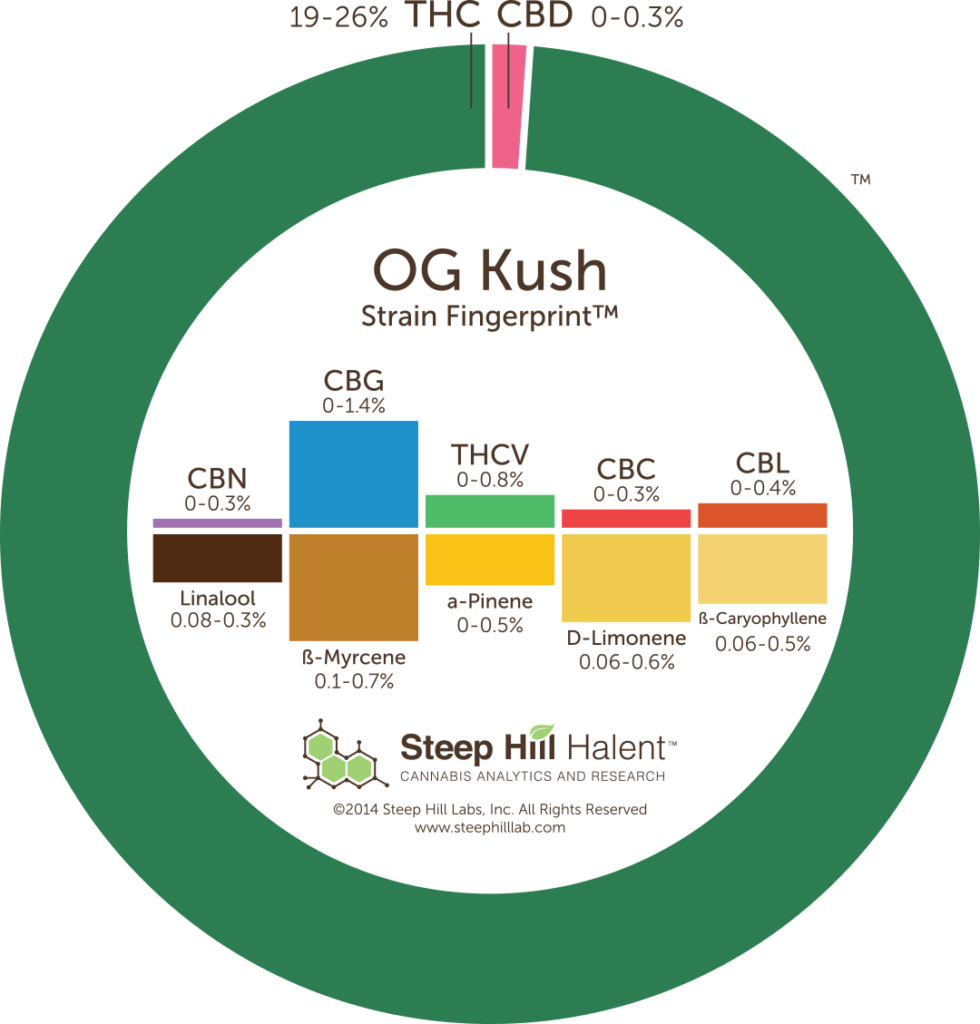
image creadit: thecannabist.co


