canna 1

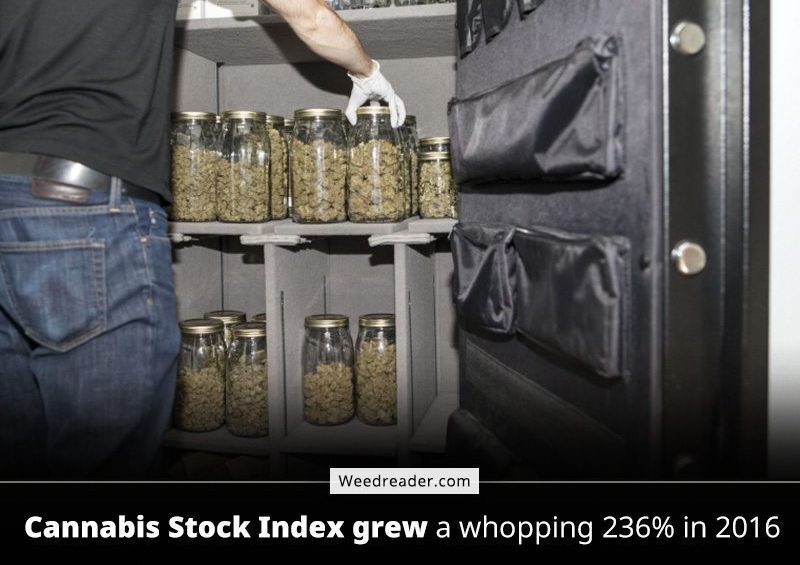
Cannabis Stock Index grew a whopping 236% in 2016

Cannabis-heavy stock portfolios are becoming as hot a topic as tech startups were the late 1990s. But Viridian Cannabis Stock Index seems to have the sunniest outlook, indicating a growth of 236 percent in 2016. That includes an almost 31 percent increase in the third quarter and 155 percent in the fourth quarter.
The one marijuana business listed on the New York Stock Exchange is called Innovative Industrial Properties; you may have heard of them because of their IPO in November. Although they are the only publicly traded marijuana industry stock on the NYSE, Innovative Industrial Properties is not really in the production or sales of pot. They are a Real Estate Investment Trust company that rents commercial properties out to the people who do the growth and storing of America’s fastest growing cash crop. After opening at 19.75 per share, the stock (listed as IIPR) dropped to 15.29 by December 5 and then climbed back to 18.14 on February 3, 2017.
The Cannabis Stock Index
Meanwhile, on the Over-the-Counter Market, Viridian Capital Advisors developed the Cannabis Stock Index, to keep tabs on 50 publicly traded legal marijuana companies starting in 2016. The index is categorized by the 12 different product/technology sectors that comprise the businesses that “touch the plant” and other core businesses of the legal cannabis industry that don’t. They include:

  • Agriculture technology
  • Biotech/pharma
  • Consulting services
  • Consumption devices
  • Cultivation & retail
  • Hemp
  • Investments/M&A (holding companies)
  • Infused products & extracts
  • Miscellaneous ancillary
  • Physical security
  • Real estate
  • Software/media

How does a business make it into the Cannabis Stock Index? They must meet the following criteria:

  • A $10 million market capitalization
  • An average daily trading volume of at least $20,000
  • A float (outstanding shares) of at least 25 percent
  • Financial reports filed on time for at least the last six months

The index is not yet tradable, though they are looking at future opportunities to convert it into a tradable entity. Still, it does offer insight into how marijuana investors are doing at a time when potential investors are taking a keen interest in Viridian’s weekly index status report on the state of the index. The Cannabis Index rose in a big way in the second half of last year, not surprising as legalization brought the US closer to full legalization.
Photo credit: Heath Korvola | Getty Images

w drop

As Legal Weed Price Drops, What Can States Learn from California and Alaska?

One of the amazing things about Colorado’s booming cannabis economy is that it means production costs are steadily falling. But what does that mean for the tax revenue that has stringent ties to the wholesale prices? It’s a conundrum that is going to challenge the state throughout 2017 to keep weed profitable.
How cheap is legal marijuana becoming in Colorado? According to the Washington Post, Colorado’s Department of Revenue puts it at $1,471 per pound. That is a 24.5% drop from last year’s peak value. And sure, Colorado consumers and pot tourists have reason to celebrate, but it does create a stumbling block for policy-makers who have tied the wholesale price to the total amount of tax revenue they collect. Colorado charges a 15% tax on weed production. In 2016 that meant 15% cut of $1,948 per pound. But in 2017, that will mean 15% of only $1,471 gets collected.
It’s not just Colorado facing falling tax revenue. In all, it is something that Washington, Maine, Massachusetts, Oregon, and Nevada will have to confront as well before their marijuana prices reach their lowest levels, which experts predict could go as low as $50 per pound. For all of these states to continue turning a profit—and funding state programs, like education, infrastructure, and civic projects—from the nation’s biggest cash crop, policy and the collection of taxes from cannabis must evolve.
Luckily, California and Alaska seem to have already hit on a sustainable plan for their future that will allow cash to flow, and consumers to enjoy low weed prices. Alaska has a $50 per ounce flat tax that remains steady no matter what the wholesale price of pot reaches. In California, they levy a similar flat tax on growers, which keeps the state’s profits more steady even if wholesale prices drive their taxable revenue down. If the early-adopting states plan to keep their respective markets profitable, experts suggest they take note.
image: Brennan Linsley/AP

canada pot

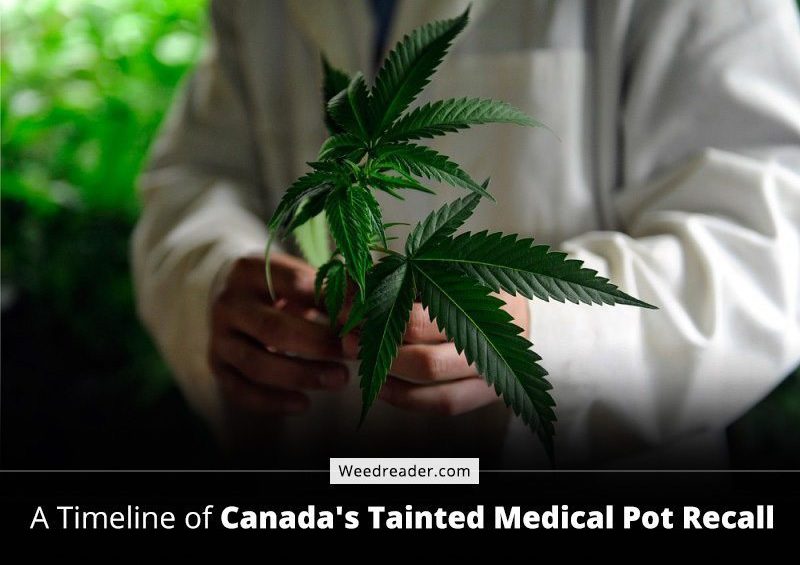
A Timeline of Canada's Tainted Medical Pot Recall

Health Canada is about to start randomly testing of medical marijuana products from all of its licensed producers, especially looking for the presence banned pesticides. Here, in a timeline, are the events that lead to this Health Canada decision.
Late last year: Two of Canada’s licensed producers—Organigram of Moncton, N.B., and Mettrum of Toronto—voluntarily recall products because they contained myclobutanil, bifenazate and pyrethrins, three chemicals that are prohibited in the production of tobacco and marijuana.
January 2017: Nearly all of Organigram’s products sold in 2016 were pulled in a higher-level voluntary recall. Product recalls affected about 25,000 customers in total and some reports of illnesses could mean the possibility of a class action lawsuit down the road.
Last Tuesday evening: Health Canada releases an additional statement announcing a new measure beyond the recall, saying that it will begin random testing of medical cannabis products produced by all licensed producers. The testing will specifically target pest control products in the production of medical cannabis. “The expanded product testing program will further enhance the department’s existing regime of regular unannounced inspections of licensed producer facilities, as well as the controls in place by licensed producers,” reads the statement.
Now: A lawsuit is yet to be filed, but CBC News in Canada reports that more than 90 medical marijuana patients have contacted a medical malpractice law firm in Halifax.

1b weed

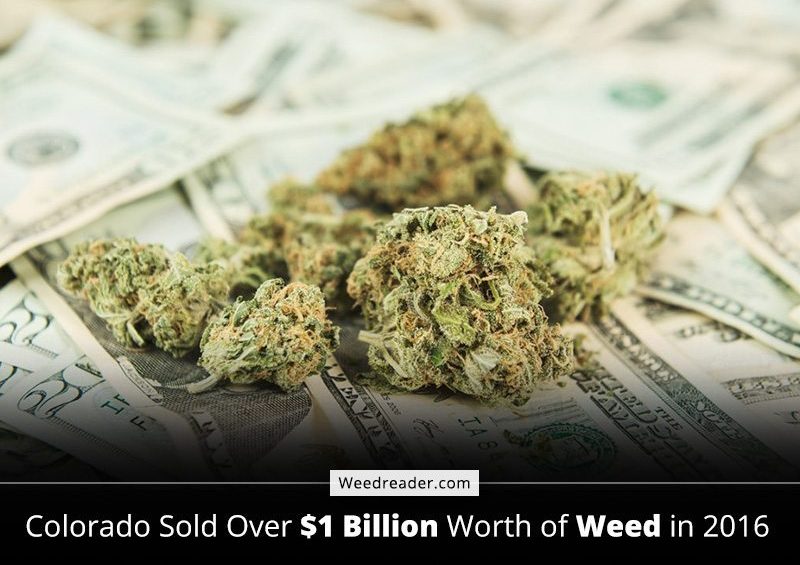
Colorado Sold Over $1 Billion Worth of Weed in 2016

While many people were eschewing a “terrible” 2016 and ringing in the new year with renewed hope, Colorado was counting it’s 2016 cannabis tax revenue with glee. On Thursday, the Colorado Department of Revenue released the much-anticipated tax data for 2016, showing that nearly $200 million in marijuana tax revenue. Of the $1.3 billion in legal cannabis sales in Colorado, $875 million came from the recreational market and $438 from the medical market. In comparison, the state sold $996 million in 2015 (with tax revenue reaching $135 million) and $699 million the year prior.
The news isn’t a complete surprise as journalists, policy-makers and cannabis advocates have been talking a lot about the mid-year sales numbers since before the month of May even closed out. What observers saw were cannabis sales exceeded $100 million per month for two-thirds of the year, topped off by a whopping $114.7 million month in December.
Director of communications for Denver’s Marijuana Policy Project, Mason Tvert, says “This money is just the tip of the iceberg. The state is also reaping the invaluable public health and safety benefits of replacing an underground market with a tightly regulated system. Marijuana is now being sold in licensed businesses, rather than out on the street. It is being properly tested, packaged, and labeled, and it is only being sold to adults who show proof of age. The system is working.”
The only part of the system that remains to be a concern is the recent price drop in the wholesale cannabis market. That, and the fact that fewer people are visiting the state for reasons of pot tourism. But, Colorado does not seem fazed by these side developments as the green rush of the Rocky Mountain State only grows greener every year.

cann history

A History of Medical Cannabis Part 2: Modern Cannabis

In Part 1 we talked about ancient cannabis and how it has been used throughout the ages.

Today we are going to talk about modern cannabis and how it moved from prominence as a medicine to a recreational drug. Yet medical cannabis is not relegated to the ancient past. Modern medicine uses the term marijuana instead of the ancient name: cannabis but it means the same thing.
The original name can be traced back to the Greek physician Pedanius Dioscorides. He was a roman army doctor from around 40-90AD who traveled widely on campaigns throughout the Roman empire. He wrote the medical text that virtually all others were based on for over a thousand years and had a special entry for both male and female cannabis plants. It wasn’t until the 1930’s when the plant became known a marijuana in an effort to re-brand it. But I’m getting ahead of myself.

By 1621, medical marijuana had made its way into the English Mental Health Book.

Cannabis was entered into one of the most popular medicinal textbooks from the era to treat depression. Because of the work of an Irish doctor working for a shipping company during the colonization of the new world, medical cannabis moved to the Americas.
Cannabis treatments were a staple of a professional doctors curriculum up through the industrial revolution.  Before Alaska and Hawaii were states, America had laws on the books that supported medical marijuana in all 48 states. Cannabis was not seen as a recreational drug, it was medicine with little risk of side effects.

But in 1936 all that changed.

Pressure was being placed on the U.S. by the international community to sign the International Treaty on Controlled Substances. While not directly listing cannabis as a controlled substance, the treaty forced all countries that signed to adopt similar drug policies. Propagandists later used the treaty to get cannabis banned across the developed world.
A very popular anti-marijuana campaign burned through the nation. Funded by the government and directed by the talented propagandist Larry Anslinger, “Reefer Madness” was a sensational tale about marijuana. It featured the plant ruining people’s lives through sex, insanity, and horrific acts of violence. Although Reefer Madness was a work of pure fiction,  it was accepted by a whole generation as fact with the tenacity of religious convictions. The influential power of the Reefer Madness propaganda laid the groundwork for Larry Anslinger to get cannabis banned.
Larry Anslinger was a potent propagandist that was able to convince the developed world to outright ban cannabis use, cultivation and distribution. He used a mixed media of propaganda to accomplish this. Anslinger was a master of using media and used the newspapers, radio and television to spread a web of half-truths and outright lies.
After spreading a racially motivated panic with the Reefer Madness propaganda, Anslinger convince the U.S. to pass the Marijuana Tax Act of 1937. Anslinger provided his political masters a new way to target their political opponents voting base. The politically motivated police force acted quickly on the new laws to target the poor.

The Marijuana Tax Stamp Act brought America Modern Cannabis.

On the day the Marijuana Tax Stamp Act was enacted (Oct. 2, 1937) the FBI and Denver Colorado police raided the Lexington Hotel. They arrested a man named Samuel R. Caldwell for selling modern cannabis. He was a 58 year-old unemployed laborer. Three days later, on Oct. 5, 1937 Caldwell became the first person convicted under U.S. federal law of distributing cannabis.
In 1942, cannabis was removed from the U.S. Pharmacopeia. When that happened, cannabis lost the last vestiges of medical legitimacy. Because of the International Treaty on Controlled Substances, most of the other countries in the developed world were forced to enact similar rules.

Over the next decades, criminalization of cannabis continued.

As more and more regulations were heaped on medical practitioners, they became unable to prescribe cannabis. Legal penalties increased massively with the Boggs Act of 1951. It established minimum prison sentences for simple possession of cannabis. Thanks in great part to Anslinger’s work, cannabis was classified as a schedule 1 controlled substance in 1970.
Schedule 1 substances are substances no medical benefit and high risk of abuse. The controlled Substances Act of 1970 Classified Marijuana as a having “No Accepted Medical Use”. After the passing of the Substances Act, medical practitioners were barred from prescribing modern cannabis for any medication, effectively removing the oldest known medicine from a whole generation of healers across the globe.
In 1971, the Shafer Commission was created by the U.S. president to determine the merit of criminalizing cannabis. The Shafer Commission was bi-partisan and overseen by congress. President Nixon himself ordered it to determine “if the personal use of marijuana should be criminalized.” The commission came back with an answer and Nixon ignored it because he didn’t like that they believed there was no reason to scale up action against users.
In 1971 president Nixon chose to aggressively pursue action against cannabis consumers by declaring the War on Drugs. Motivated by personal prejudice political corruption, he saw marijuana as a way to get at his political opponents. He even admitted at the time that his reasons for attacking cannabis users and increasing penalties was motivated by personal directives.

Nixon acknowledged his action was not based on empirical evidence.

He increased criminalization despite the commission he put together telling him officially and unequivocally that cannabis use should not be criminalized. Over the next two years, the Nixon built a force specifically designed to scale up violence against modern cannabis users.
The Department of Drug Enforcement (DEA) was established in 1973 by merging the Bureau of Narcotics and Dangerous Drugs (BNND) and the Office of Drug Abuse Law Enforcement (ODALE) into a single agency. It comes as no surprise that the DEA continues to aggressively pursue cannabis consumers, producers and distributors to this day. They use every tool at their disposal regardless of legality or constitutionality to continue the criminalization of marijuana.
Things continued to go downhill for cannabis in the coming years. It wasn’t until 1976 that Robert Randall (who was afflicted by glaucoma) used the Common Law Doctrine of Necessity (US v. Randall) to defend himself against criminal charges of marijuana cultivation. In 1976, federal Judge James Washington made waves with his ruling. Judge Washington ruled that Randall’s use of modern cannabis constituted a ‘medical necessity’ and the case was thrown out.
Modern cannabis 2

The next milestone for modern cannabis crusaders came in the winter of 1991.

Modern cannabis took a step forward with the passing of medical marijuana reform in California. The first medical marijuana initiative was called Proposition P and was in San Francisco. It passed with an overwhelming 79% of the vote in November of 1991.
Proposition P called on the State of California and the California Medical Association to restore hemp medical to the list of available medicines in California, and to stop penalizing physicians for prescribing hemp for medical purposes. It only effected San Francisco but the cogs of bureaucracy had been activated. It would take another 5 years for legislation to go statewide.
Voters in California passed the first statewide medical marijuana initiative on November 5, 1996. Known as Proposition 215, it permitted patients and their primary caregivers to possess and cultivate marijuana for the treatment of AIDS, cancer, muscle spasms, migraines, and several other disorders. It also protected doctors from state sponsored punishment if they recommended marijuana to their patients.

The wheels of bureaucracy turn slowly.

In September of 1998, the House of Representatives debated a resolution called H.J.Res. 117. They passed H.J.Res 117 at the same time Oregon, Washington and Alaska provided their medical marijuana programs. In H.J.Res. 117, Congress declared support for the existing federal drug approval process.
They decide not to reschedule marijuana despite the overwhelming evidence coming forth that it should be decriminalized. While cannabis is classified as having no medical benefit, the United States Department of Health and Human Services) currently holds a patent on medical cannabis.
Patent No. 6630507 covers the use of cannabinoids for treating a wide range of diseases and was submitted to the patent office in 1999. The Department of Health and Human Services was awarded the patent in 2003. Yet the Department of Health is not the only regulatory agency that has chosen to abandon science, compassion and reason.
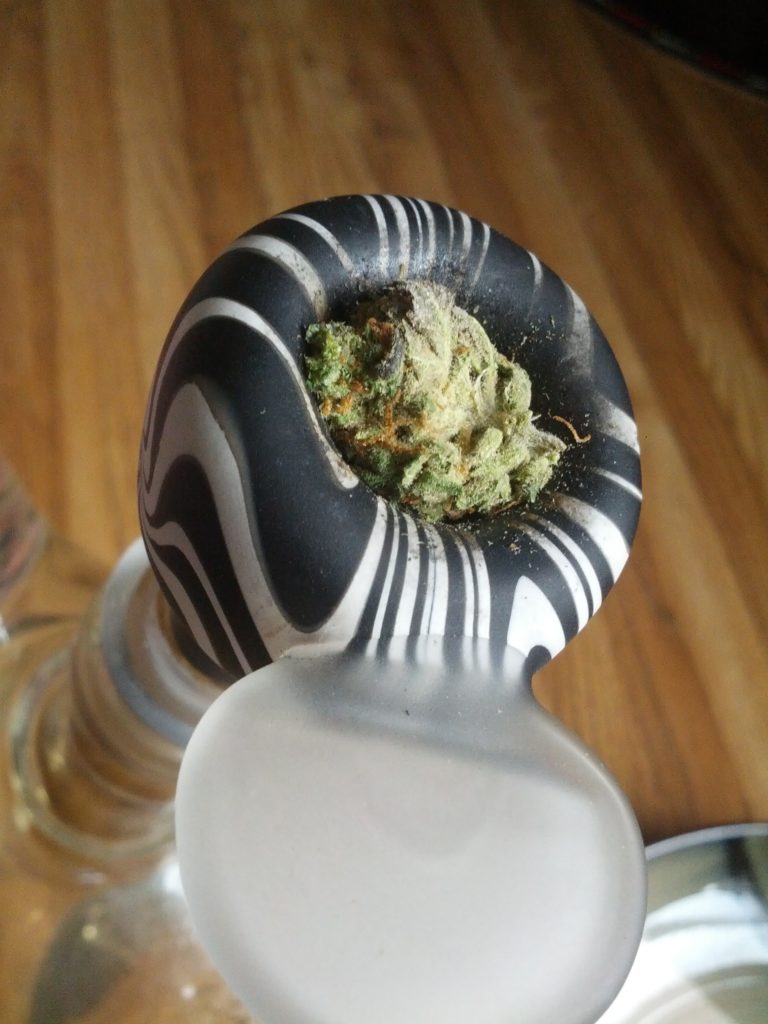
Modern Cannabis

In 2002, the FDA decided how to use modern cannabis in a study.

They decided that shipping 300 pre-rolled joints to patients in metal canisters was the best way to judge modern cannabis. The material was frequently two or more years old upon receipt by patients and a close inspection of the contents of NIDA-supplied cannabis cigarettes revealed them to be a crude mixture of leaf with abundant stem and seeds.
The study concluded that “cannabis smoking, even of a crude, low-grade product, provides effective symptomatic relief of pain, muscle spasms, and intraocular pressure elevations…” and that “clinical cannabis patients are able to reduce or eliminate other prescription medicines and their accompanying side effects.” The FDA report was ignored by those in power and cannabis remained a schedule 1 controlled substance despite the undeniable evidence.
The DEA has still not reclassified cannabis. It remains a holistic herb used throughout time as a medicine that current U.S. legislators are violently opposed to. While international progress has been made with the UK rescheduling cannabis to Class B and the Netherlands also making great strides in medicinal research, the U.S. still struggles to come into the light. Use of scientific reasoning is about to get even harder for the U.S. government as President Trump decides who will take the reigns of power. Yet his choice of Jim O’Neill to head the FDA (who openly supports cannabis legalization) gives modern cannabis hope for the future. Only time will tell. Thanks for reading.
Featured image: shutterstock

Recreational Marijuana

The Wave Of Recreational Marijuana Hits The East Coast

New Recreational Marijuana States

It wasn’t all bad news on election night, several new states now have access to legal marijuana. Voters in Maine, Massachusetts, California, and Nevada passed recreational marijuana laws. Legal weed is now available to about 20 percent of adults in the United States. Until recently, recreational marijuana has only been available on the west coast and Colorado. However, the wave of recreational marijuana has finally hit the East Coast with states like Maine and Massachusetts. Both states had medical marijuana laws in place prior to this year’s election.

Maine

The vote for recreational marijuana in Maine barely passed with 51% of the vote. 49% were in opposition, the numbers were so close that opponents are pushing for a recount.Opponents only need to collect 100 signatures for the Secretary of State’s office to consider taking another count. Some opponents claim that the vote passed by a fraction of a percentage.
“The margin is razor thin, there are more than 375,000 people in the state of Maine that voted against this,” Newell Auger of No on 1 told WCHS. “It demands a careful, accurate result, and the idea that we are going to push on through when the margin is .005 [percent] is foolhardy.”
However, the latest recount has the law passing 381,060 to 376,658.
“We are talking thousands of votes difference,” countered Yes on 1 campaign manager David Boyer. “I just don’t see them making up that ground. Those votes can flip our way. We are ready to move forward with implementation.”
If the recount doesn’t happen, Maine voters can expect the right to grow, sell, manufacture, and distribute marijuana and it’s products. The state will be implementing a 10 percent tax and local governments can opt to implement local rules on retail sales. Within the next 40 days, adults will be able to carry up to two and a half ounces of pot and grow up to six plants. Maine and Massachusetts are the first two states on the east coast to go the recreational marijuana route. Maine’s state motto is “I’ll lead.” Hopefully the rest of the East coast follows their lead.

Massachusetts

Despite having an anti-pot governor, Massachusetts voters decided to pass a measure called Question 4 which legalized recreational marijuana. Question 4 will tax the use and sale of marijuana similarly to alcohol. So, only adults ages 21 and up can purchase marijuana. Only an ounce is allowed in public but 10 can be possessed at your home.
Don’t get too excited though, retail sales aren’t scheduled to begin until 2018. When retail sales begin, out of staters will also be permitted to carry an ounce at a time. Tourism might rise in the Mile “High” City because few other places on the East Coast offer legal marijuana to visitors. Maine will be Massachusetts only competition in the East.
Local communities are looking forward to the expected boost in tax revenues and jobs created from the booming cannabis industry.
“A century-long mistake has been abolished!” Yes on 4 communications director Jim Borghesani told a crowd of supporters of the ballot question. “Voters chose fact over fear and rational arguments over hysteria.”

Recreational Marijuana might be hurting Medical Marijuana

Recreational Marijuana might be hurting Medical Marijuana

There are now multiple states with recreational and medical marijuana. How is recreational marijuana impacting the medical marijuana community? The number of recreational users is on the rise.  Meanwhile, in states with recreational marijuana, medical marijuana users are dropping. We look to a report by GreenWave Advisors for answers.
So far, the report shows medical marijuana patient numbers dropping in states with recreational marijuana. Some people think this is because people were falsely reporting medical conditions just to obtain weed. For example, someone could claim chronic pain and fake until the doctor recommends medical marijuana. It’s worth noting, chronic pain is the most common qualifying condition.
Furthermore, when retail marijuana becomes available it’s the number of chronic pain patients that declines the most. According to the analysts’ report, patient counts dropped in Oregon, Colorado, and Washington D.C. States like Washington don’t even count their patients so we don’t know if numbers dropped there.
Arizona has recreational marijuana on it’s November ballot. There’s already a decrease in the number of medical marijuana cardholder applications. The number dropped a whole 73% in May. GreenWave believes that it is “in anticipation of a favorable election outcome for recreational use.”
With laws that take away medical marijuana users right to bear arms, it’s no wonder people would rather wait on recreational marijuana. The pain of applying and paying fees to get pretty much the same weed you could get at a recreational location could have lowered the number of applicants as well.
GreenWave also believes that as long as cannabis remains a schedule 1 drug, doctors will be hesitant to recommend it to patients. This isn’t helping the already decreasing number of medical marijuana patients.
The report also predicted that states would begin to combine the regulation of the recreational and medical marijuana markets. The report explicitly states, “Redundancy in oversight and enforcement mechanisms will be recognized as costly and confusing.”
Fortunately, the report doesn’t believe this is the end for the medical marijuana market. If marijuana becomes rescheduled doctors will become more involved with the medical market. GreenWave believes this will lead to a revival of the medical market. In fact, many doctors in states where it is legal still refuse to recommend marijuana due to its federal status.
The way the markets work in states with both medicinal and recreational marijuana is raising questions. There is no substantial difference between recreational and medicinal marijuana. However, the two are being sold for different prices in different markets. In states like Arizona that have a 15% tax rate on recreational marijuana and a 6.6% tax rate on medicinal might not see as much of a decrease in their medical marijuana communities.
Similarly, Colorado hasn’t seen a huge decrease in medical marijuana sales. In CO medical marijuana is only taxed at 2.9 percent. While recreational marijuana is taxed at a whopping 27.9 percent. People in states like Colorado and Arizona might still have the incentive to fake chronic pain. It’s nice that patients who need marijuana don’t get taxed too hard but that might change if GreenWaves predictions come true. Then, the two markets would merge and everyone would be paying the same prices for the same product.
Photo: katherine_hitt/Flickr

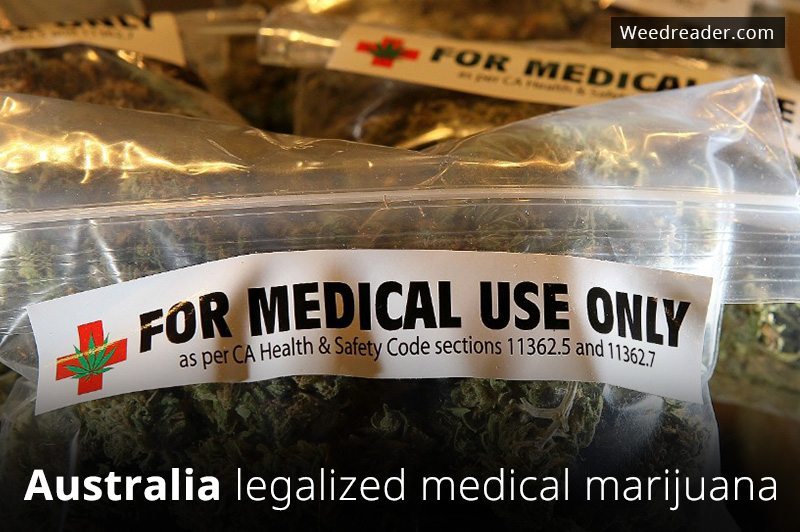
Australia legalized medical marijuana

Australia legalized medical marijuana

Australia legalizes Medical Marijuana

Australia made the bold move this week to legalize medicinal marijuana use for the whole country. The Therapeutics Goods Administration was the one to make the decision. Medicinal marijuana will be legalized but strictly controlled. Parliament passed the measure on Wednesday and the amendments to the Narcotic Drugs Act will allow Australians to legally grow cannabis for medical and scientific purposes for the first time.
“This is a historic day for Australia and the many advocates who have fought long and hard to challenge the stigma around medicinal cannabis products so genuine patients are no longer treated as criminals,” Minister of Health Sussan Ley said in a statement.
“This is the missing piece in a patient’s treatment journey and will now see seamless access to locally-produced medicinal cannabis products from farm to pharmacy,” she said.

The Death of Daniel Haslam

A 25-year-old by the name of Daniel Haslam lost his life to terminal bowel cancer. Before that, his parents were his dope dealers. A seasoned nurse and police officer were giving their son marijuana to ease his chemotherapy symptoms. He suffered from uncontrolled nausea and vomiting after every chemotherapy session.
His parents were desperate to end his suffering and another cancer sufferer recommended pot. After trying cannabis his mother claims his life became “a little more tolerable. A sick young man reluctantly tried a joint and just like that, he felt so much better. He gained an appetite, had his nausea and vomiting addressed and was able to maintain his weight through his ongoing treatment.”
Dan’s final months were made more comfortable because his parents were willing to risk criminalising themselves to ease his pain. Many other people have been prosecuted for doing exactly what Dan’s family did.
Dan’s dying wish, was for others to experience the unique qualities of cannabis when suffering as he did. His mother, Lucy Haslam, started a petition to make medicinal marijuana more accessible to sick and suffering Australians.
It was this story that touched the Australian parliament and got the law passed. Suffering Australians who will benefit from this law change have Dan Haslam to thank. Australian Sen. Richard Di Natale was the one who brought up Haslam’s story to parliament.
“It is incredibly fitting that today we are passing this bill which is one step towards making medicinal cannabis accessible to people like Dan,” Di Natale said.
“Thank you to Lucy for everything you have done. Please know that your family’s grief, pain and suffering has not been in vain and this is a legacy that Dan will leave here in Parliament.”
Lucy Haslam’s main concern with the recent passing of the law is the pricing of medicinal cannabis, as well as the lack of education on the matter.
“My fear is that the industry will become so expensive that patients won’t be able to access a legal supply at an affordable price,” said Haslam. “There’s also a lot of work to do on educating people and doctors, some of who remain a bit uncomfortable about prescribing medical cannabis to patients.”
Australians hope the new laws will benefit those suffering and bring money into the country.
Featured photo credit: Getty images

More College Students are Choosing Marijuana over Opioids

More College Students are Choosing Marijuana over Opioids

The amount of cannabis being consumed by college students is on the rise, while the use of other drugs like amphetamines and opioids is decreasing. Studies have linked decreases in opioid abuse to the availability of marijuana.
The number of college students who admitted to using pot within the last year was at 30 percent in 2006. This number jumped up 8 percent by 2015, according to a study conducted by the University of Michigan Institute for Social Research.
University students who smoked pot daily reached 6 percent in 2014, the highest it has been in 34 years. However, this number dropped below 5 percent in 2015.
HealthDay believe the perception of risk when it comes to marijuana has dropped among college students. According to the same report, the number of young adults between ages 19 and 22 who perceive marijuana to be dangerous fell from 58 percent in 2003 to 33 percent in 2015.
“This increase in use and decrease in perceived risk of harm regarding marijuana use should be taken seriously by college administrators, parents, and students themselves,” said the co-lead researcher of the study, John Schulenberg. “We know through other research that frequent marijuana use can adversely affect academic performance and college completion,” Schulenberg said in a University news release.
On the bright side, students are using less of other drugs. Nonmedical use of prescription opioid drugs in the past year was at 9 percent in 2006. This number dropped to 3 percent in 2015. This includes commonly abused opioids like oxys, vikes, percs, and Fentanyl. Heroin use even declined from .3 percent in 2005 to .1 percent in 2015.
“It appears that college students, at least are hearing and heeding the warnings about the very considerable dangers of using narcotic drugs,” said the principal investigators of the study Lloyd Johnson, a senior research scientist and research professor at the institute.
The “Monitoring the Future” study surveys between 1,000 and 1,500 college students a year. The study also found that K2 or synthetic marijuana use went from 3.5 percent in 2011 to under 2 percent in 2015. This may be due in part to K2’s growing illegal status and marijuana’s increasing legal status.
In 1999, cigarette usage was at 31 percent. In 2015 it was at 11 percent. This is likely due to the increase in popularity of “e-cigarettes” and vaporizers.
Illicit amphetamine use nearly doubled between 2008 and 2012, when it reached 11 percent. However, fewer than one in 10 students said they used amphetamines in 2015, the study found.
“It appears that the increase in nonmedical use of prescription stimulant drugs may have passed its peak, though about one in 10 college students still report using them in the prior 12 months,” Johnston said.
As more and more college students become aware of the fact that marijuana is a less harmful alternative to opioids, the number of pot users will continue to rise as opioid abuse falls.
The only problem is the DEA keeps putting safer alternatives to opioids on the schedule I list of the Controlled Substances Act. The DEA recently decided to leave marijuana on the schedule I list. Kratom, an herbal supplement that people were using to quit opioids will be moved to the schedule I list by the end of this month.
 

Marijuana abuse has decreased even though marijuana use increased

Marijuana abuse has decreased even though marijuana use increased

Marijuana abuse has decreased even though marijuana use increased
With marijuana becoming legalized in more states across the US, more people are beginning to use marijuana. Many would assume that this would lead to an increase in marijuana abuse. Opponents of legalization have even used this as an argument against legalization. However, the Center for Disease Control and Prevention has recently released results that reveal marijuana abuse and dependency is at an all-time low over the past decade and a half. The report was released on Thursday by both the Substance Abuse and Mental Health Services Administration and the Center for Disease Control and Prevention.
The report showed 1.6% percent of Americans aged 12 and over were considered to be abusing marijuana or suffering from marijuana dependency in 2014. In 2002 1.8% of Americans aged 12 and over were found to be abusing marijuana or dependent on it.
Another argument made by opponents of marijuana legalization is that teen usage would increase. However the results from the CDC’s reports would beg to differ. The largest decrease in marijuana abuse and dependency was seen in teenagers. 37% less teenagers were abusing marijuana in 2014 than they were in 2002. Young adults also saw an 18% decrease in abuse over the same period. The number of adults aged 26 and older did not see a big change in the number of adults abusing marijuana since 2002. This may be due to a former lack of information and education on marijuana. Marijuana is being introduced to people as medicine and legalization allows for education and regulation, which may lead to a decrease in marijuana abuse.
It’s safe to say the results represent a national sample. The National Survey on Drug Use and Health, a massive annual federal survey of American substance use, received 900,000 responses. Respondents were considered dependent if they claimed to have “health and emotional problems associated with [marijuana] use, unsuccessful attempts to reduce use, tolerance, withdrawal, reducing other activities to use [marijuana], spending a lot of time engaging in activities related to [marijuana] use, or using [marijuana] in greater quantities or for a longer time than intended,” said the CDC.
Respondents were considered to be abusers of marijuana if they reported “problems at work, home, and school; problems with family or friends; physical danger; and trouble with the law because of [marijuana] use.” This could mean a respondent who only smokes once a week and got into trouble with the law could be considered an abuser as well. Despite this, the number of abusers is still going down.
The study found that abuse and dependency when it came to marijuana was rare. Only about 12 percent of people who used marijuana in the past year fit into either of those categories. This number was 16.7 percent in 2002 which is a 30 percent decrease in the 12 year marijuana’s accessibility has increased.
According to the data, marijuana accessibility is helping more than it is hurting the country. Informing people about a drug while regulating it seems to decrease abuse more than full on prohibition. With more evidence on the benefits of legalization we hope to see most if not all of the nine states voting on marijuana legalization this November to go legal and reap the benefits.
image credit: bigstock