wr post

UPDATE: Jeff Mizanskey Up For Parole

 
In a previous article, we told the story of Jeff Mizanskey, a 61 year old man from Sedalia, MO serving a life sentence for possession of marijuana. Jeff was a victim of the “three strikes” laws and their harsh mandatory minimum sentences, and has been behind bars since his third arrest in 1993.
That’s more than 20 years in prison. For pot.
But a breakthrough came for Jeff and his family yesterday, when Missouri governor Jay Nixon commuted his sentence, making him eligible for parole. By all accounts, Mizanskey has been a model prisoner, and his application  for parole is expected to be approved. The hearing could be scheduled as soon as August.
Jeff has become something of a poster boy for legalization activists. The commutation of his sentence should be taken as a very encouraging sign that the times are changing, and that cannabis laws are changing with them.
Even in the conservative American Midwest.
Nixon also granted clemency to five other non-violent drug offenders: Michael Derrington (who was also convicted of pot possession), Bill Holt, Nicole Lowe, Doris Atchison, and Earl Wolf.

roger williams1

The Healing Church Smokes Weed at Roger Williams National Monument

Yesterday, on May 17th 2015, a group of five people gathered for a religious ceremony at the Roger Williams National Monument in Providence, Rhode Island. Such a small crowd might have gone unnoticed and unreported, but for the fact that they were members of The Healing Church — and they were smoking weed.
The setting is most appropriate: Roger Williams was an early settler and Protestant Reformer who founded the town of Providence in 1636, after he was exiled from Salem, Massachusetts for preaching unpopular doctrines. Those ideas that were so demonized are sacred to us now, such as the separation of church and state, the abolition of slavery, and the rights of Native Americans. The monument that bears his name also enshrines the values of universal human rights and religious freedom.
So it’s only fitting that The Healing Church would choose it as a place of worship.
The religious ceremony was led by Anne Armstrong, ordained minister since 2002. She led the group in prayer, which included smoking marijuana and annointing members foreheads with cannabis oil. It didn’t take long for park officials to take notice, and soon enough a park ranger came to inquire. They told the church members that they could not violate the Controlled Substances Act on park grounds. Armstrong presented her ordination papers, as well as a permit that she had acquired to hold a church service of 100 people in the park on May 23rd, 2015. Park officials tried telling her that the group needed a permit for their gathering yesterday, but Armstrong defended the groups right to assemble, to pray, and to use cannabis as a religious sacrament, citing a 2010 free speech ruling (Boardley v. U.S. Dept. of Interior) that upholds the right of small groups to gather and express themselves in public parks.
The group then proceeded to smoke and pray for another hour, with being disturbed. On their way out of the park, they were questioned by the police, and that encounter was recorded and posted to YouTube:

As you can see, there were no fines, citations or tickets issued (personal use is decriminalized in Rhode Island; possession of less than an ounce warrants no arrests or jail time). It was a peaceful end to a peaceful gathering, and it sets a major precedent in the move toward cannabis legalization and decriminalization.
It may not seem like a big deal at first glance, but it is. A group of citizens were able to smoke pot on government property and walk away unmolested. Constitutional rights—freedom of speech, freedom of assembly, and freedom of religion—triumphed over the federal ban on cannabis and controlled substances. That’s pretty big.
It clearly shows that there is indeed a seismic shift going on in the way the public, the government, and even law enforcement approaches marijuana. If it can happen in Providence, it could happen anywhere.
Cannabis smoking could be coming soon to a park near you 😉
statue of Roger Williams, photo from wikipedia

ben jerrys releases new snack

Ben & Jerry's Releases New Snack for Stoners

Rumors have been swirling that Ben & Jerry’s ice cream is working on a new cannabis-infused product, and they have just announced that they are indeed releasing a new frozen treat… sans cannabis.
The new BRRR-ito is obviously marketed to pot smokers, however. The product is being rolled out on April 20th, sort of the unofficial “National Day of Weed.” The commercial plays upon some (rather degrading) marijuana stereotypes, depicting a crowd of droopy-eyed, brain dead stoners staring at a screen. But I must say that the BRRR-ito itself (which as you might guess is basically ice cream and chocolate wrapped up like a burrito in a waffle cone shell) does look delicious. Check it out here:
 

In an interview with Huff Post Live, founders Ben Cohen and Jerry Greenfield addressed the rumors of a THC-infused treat. They definitely spoke out in favor of legalization, and even seemed keen on the idea of cannabis edibles. But the decision is not up to them. The company has to answer to a board of directors, and prove that the potential profit of a weed-laced ice cream would be greater than the risks – especially when major banks and financial institutions are refusing to do business with cannabis companies.
Still, the new BRRR-ito, and the ad campaign surrounding it, shows that big name companies have their eye on the cannabis market. They can read the writing on the wall: legalization is here to stay, and there is nowhere to go but up.
Who knows what mega brand will jump on the bandwagon next, or what new pot oriented products are yet to be unveiled? But please, no more dumb stoner stereotypes! Cannabis users are more sophisticated than that, and smart companies would do well to recognize that.


pot 13

Missouri Man Serving Life Sentence For Pot Might Be Paroled

 
On March 11th, the House Corrections Committee voted 11-1 to forward Missouri HB 978, a bill that would grant parole to inmates serving life sentences for non-violent marijuana offences. The bill was introduced in response to extensive campaigning on behalf of Jeff Mizanskey, a 61 year old grandfather who has spent more than 20 years behind bars for possession of marijuana.
Mizanskey was arrested in Sedalia MO in 1993, for being present during a drug deal gone wrong. Atilano Quintana, a known drug dealer being investigated by U.S. Customs, was picking up a hundred pounds of pot from New Mexico, and he brought Jeff along as his driver. His sources – Jose Reyes and Jorge Ibaudo – were to meet him at a local motel with the goods, but they were pulled over by highway patrol on the way into town. Cops found the drugs, and they arranged a set up to catch the buyer, Quintana, in the act. Mizanskey was just a “bonus,” in the wrong place at the wrong time.
The delivery guys were rewarded for their cooperation: Reyes served a year in county jail, Ibaudo was released without charges. Quintana, the intended buyer, and known drug dealer, served ten years.
Mizanskey was sentenced to life in prison, without possibility of parole.
Jeff is a victim of the “prior and persistent offenders” statute, which set a three-strikes-you’re-out policy for Missouri drug offenders. Only that statute was found to be cruel and ineffective, and has since been repealed (effective 1/1/2017). But the revision isn’t retroactive, and Mizanskey is still behind bars, and out of appeals. His only chance at going home to his family is for the governor to grant him clemency, or for Missouri lawmakers to pass HB 978.
If you’d like to support the #freejeffmizanksey movement, add your signature to the petition here.
 

FCOC

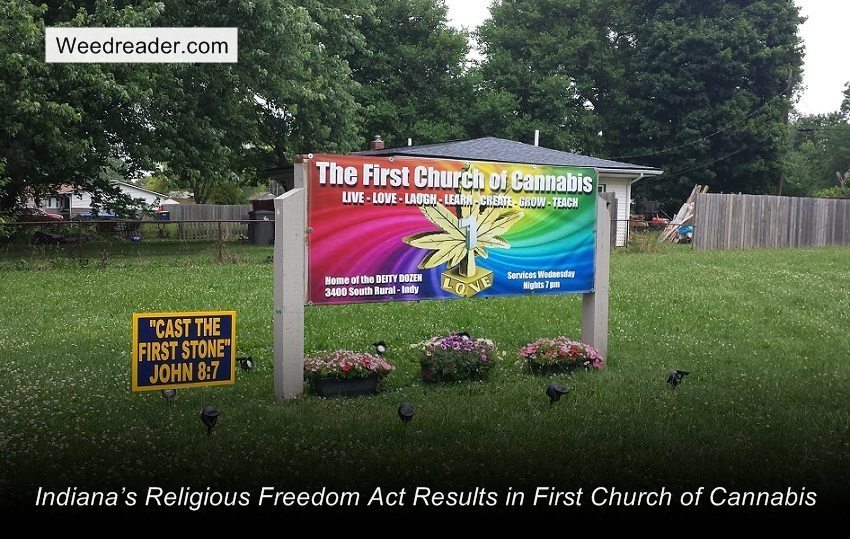
Indiana's Religious Freedom Act Results in First Church of Cannabis

Indiana signed a new bill into law last week, the Religious Freedom Restoration Act (RFRA). This controversial law was intended to protect business owners who object to serving the LGBT community on religious grounds. But it has already begun to have some unforeseen consequences…
The same day the bill was signed into law, Indianapolis businessman Bill Levin filed paperwork to start a new church called The First Church of Cannabis, Inc. The application was approved the next day.
In just six days, The First Church of Cannabis has already reached 11,000 likes on Facebook, where Bill greets his flock every morning with a message of love and encouragement, and announces the times of the communal “prayer puffs.” They have also raised more than $3,000 toward construction of their first temple – which they plan to build out of hempcrete. Members of the church are known as “cannataerians,” and will be asked for a monthly donation of $4.20.
The church doctrine lists marijuana as it’s official sacrament, and Levin (who humorously refers to himself as the “Grand Poohba and Minister of Love”) told the Washington Post that the church plans to grow hemp, although it will not be buying or selling marijuana. He also said that his new religion does not have any traditional notions of sin or guilt, and will not use any conventional holy books, but instead will teach the contents of Jack Herer’s cannabis classic, “The Emperor Wears No Clothes.”
Besides advocating for cannabis, the church also plans to offer addiction counseling, and to teach and demonstrate a proper way of life, showing love and compassion to all. Toward that end the church has established the “Deity Dozen,” a modern 12 commandments for living a good life. Number one on the list is (and I quote) “Don’t be an asshole.” The Deity Dozen also encourages members to laugh often and be positive, to grow their own food, “Don’t be a troll on the internet,” and of course, smoke cannabis.
Both medical and recreational cannabis are currently illegal under Indiana state law, but the RFRA defends a person’s right to practice their religion without being prohibited by law. Bill Levin and his cannataerians are putting Indiana’s new law to the test by claiming the right to get high as a religious freedom, a religious right.
According to RFRA, the state cannot impinge upon a citizens religious rights unless it can demonstrate a “compelling interest” in doing so. Furthermore, they must prove that it is the “least burdensome” way of achieving said interest. The pressure is now put upon the state of Indiana to prove a compelling interest in keeping people from smoking pot as a religious practice and aid to worship.
Can they prove that marijuana is a dangerous and addictive gateway drug that corrupts our youth and undermines the social order? Or did they just inadvertently give Indiana pot smokers a religious “Get Out of Jail Free” card?
Stay tuned to find out.
image via: cannaterian.org

Life in Prison… For Weed?!

When you hear of someone serving life in prison, you probably wouldn’t picture Michael Pelletier.
Michael has been in a wheelchair since the age of 11, when he was run over by a tractor on his father’s farm. In 2008 he was convicted of smuggling pot across the Canadian border into Maine. He was sentenced to life without parole.
It sounds incredible, that someone could receive a life sentence for a non-violent marijuana offense. But Michael is not alone.
Randy Lanier is a champion race car driver who is serving a life sentence in Florida. Randy was arrested for selling marijuana, his first offense. There were no weapons or violence involved. He was convicted of administrating a “continuing criminal enterprise.” He has been incarcerated since 1987.
That’s more than 20 years in prison for selling weed!
Now Randy practices yoga and meditation. He teaches classes and counsels other inmates. He writes a blog about walking the spiritual path behind bars.
George Martorano has been in jail for half of his life. He plead guilty to marijuana trafficking on the advice of his attorney, and was sentenced to life without parole. That was in 1982. George is possibly the longest incarcerated non-violent offender in the United States.
He is also an award-winning poet and a published author. He teaches Ashtanga yoga, creative writing, suicide prevention and release preparation to fellow inmates in Coleman Correctional Facility.
Kenny Kubinski is a Vietnam War veteran with three purple hearts and a bronze star. He was an active member of his small farming community; he ran a construction company and volunteered for Habitat for Humanity.
That is until 1993, when a drug task force raided his home, seized his property, and charged him with conspiracy to distribute marijuana and hashish. He was convicted on the basis of some (highly suspect) testimony from witnesses, who in turn had their sentences dropped or reduced. He is now serving a life sentence in South Carolina.
His wife Jackie was sentenced to seven years. Their three children were put into an orphanage, until friends from their church took them in.
Then there’s Larry Duke, another Vietnam veteran now serving two consecutive life sentences in a Georgia prison after being busted in a government set-up in 1989. John Knock and Claude du Boc are each serving life sentences following a 1994 case that was riddled with fraud and malpractice. Billy Dekle is serving two life sentences for smuggling marijuana into the United States in his plane – in the late 1970s.
The list goes on: Craig Cesal in Illinois, Leopoldo Hernandez in North Carolina, Andrew Cox in Virginia, Paul Free, Craig Frazier and Maurice Foley in California. Cornell Hood was sentenced to life in Lousiana – but two charges have since been dropped, and his sentence reduced to 25 years. Eugene Fischer also served 25 years of a life sentence before his sentence was reduced to time served. He was freed on July 16, 2012.
In every case, the charge is possession and distribution of pot. No guns. No violence. Just “intent” and “conspiracy.” These are people who have lost their freedom, lost their property, who lost everything, because of growing, selling, and consuming a plant.
In many cases their sentences were lengthened because they insisted on exercising their right to trial. Others are repeat offenders subject to mandatory minimum sentencing. Some were convicted based on flimsy evidence, by over-zealous prosecutors intent on seizing their sizable assets.
All are victims of the so called “War on Drugs.”
The draconian policies and harsh penalties of the late 1980s have left us quite a legacy: more than 3,200 prisoners in the United States are currently serving life sentences for non-violent crimes, most of them drug related. And while states are slowly repealing these unforgiving laws, it is too late for the men and women already behind bars for victimless crimes.
We are undergoing a sea change in the way the public thinks about drugs, and marijuana in particular. Recent polls show that more than half of Americans believe marijuana should be legalized, while an overwhelming 86 percent support its medicinal use. 76 percent of people polled said they did not think small amounts of marijuana should result in any jail time, and 67 percent of people support treatment and rehabilitation as the primary means of dealing with even hard drug use.
Meanwhile Colorado and Washington are leading the way in recreational legalization, and similar legislation is being considered in more than a dozen other states. All of which leaves me wondering…
Why on earth are people serving life sentences for pot?
free jeff mizanskey
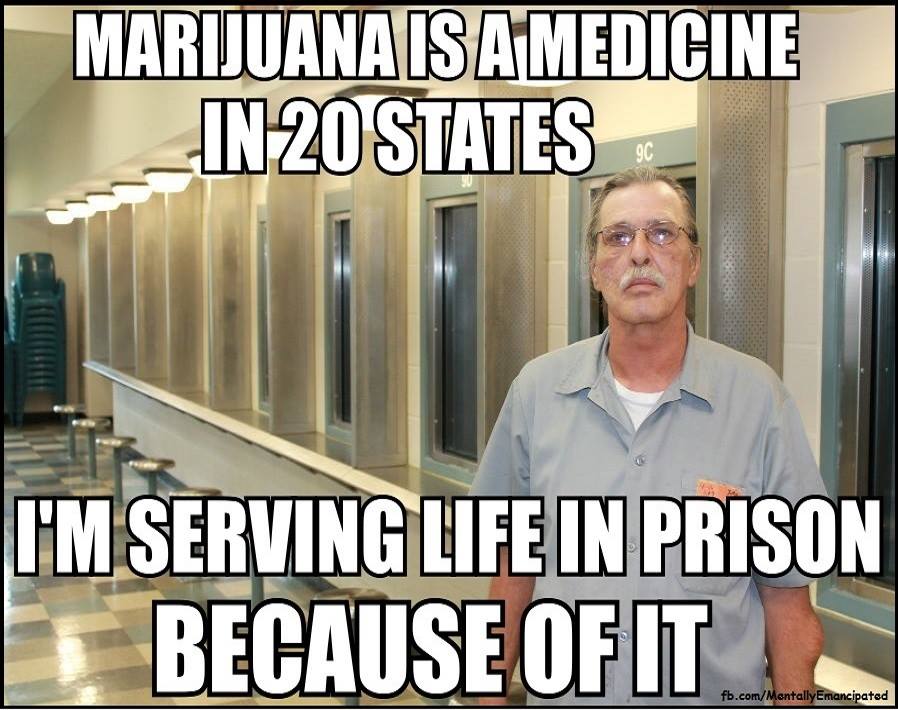
People like Jeff Mizanskey, who was arrested in 1993 for being present during a drug deal gone wrong. He accompanied Atilano Quintana to pick up a big delivery at a Super 8 motel in Sedalia, MO – unfortunately for them, the delivery guys had been busted on their way into town. The police were waiting to catch Quintana red-handed, and Mizanskey was just a bonus.
Quintana, the buyer, served ten years. Mizanskey, a repeat offender who was in the wrong place at the wrong time, got life.
Without the possibility of parole.
“Since I’ve been here in prison,” Mizanskey told an interviewer, “I’ve met lots of people in for murder, rape, robberies, all sorts of violent crimes. I’ve seen a lot of them go home on parole. Don’t I ever get a chance?”
There are at least a dozen people sentenced to die behind bars because they were caught with weed. How is this okay?
Many of these men have been exemplary prisoners, and have made the most of the rehabilitation programs available to them. And in cases like Lanier and Martorano, they have indeed gone above and beyond: becoming leaders and role-models in the prison community, pioneering new ways of teaching and rehabilitating inmates, and preparing them for their release.
Haven’t these men paid their “debt to society?” In some cases, many times over?
Visit lifeforpot.com to find out more about these men and their stories. Sign a petition, contact your congressman, join the movement calling for clemency.
Because no one should be in jail because of a plant.

UPDATE: Since this article was written Jeff Mizanskey had his sentence commuted by Missouri governor Jay Nixon. He went before a parole board on August 7th, and his parole was granted. He’s expected to be sent home to his family any day now.