dpa marijuana infographic banner 0

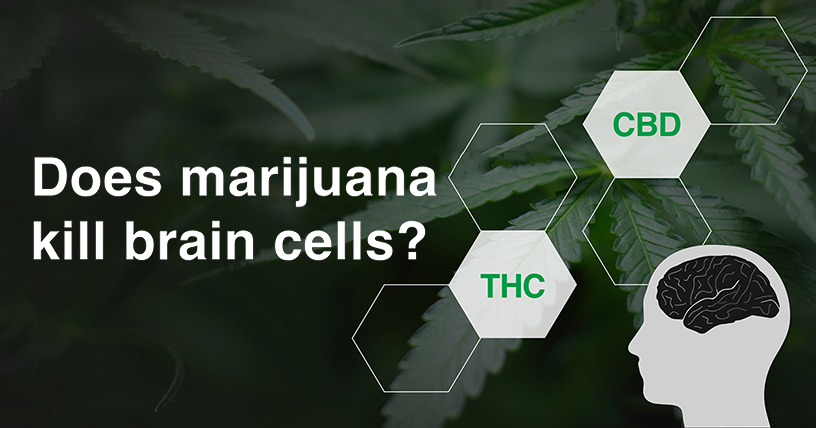
Does Marijuana Kill Brain Cells?

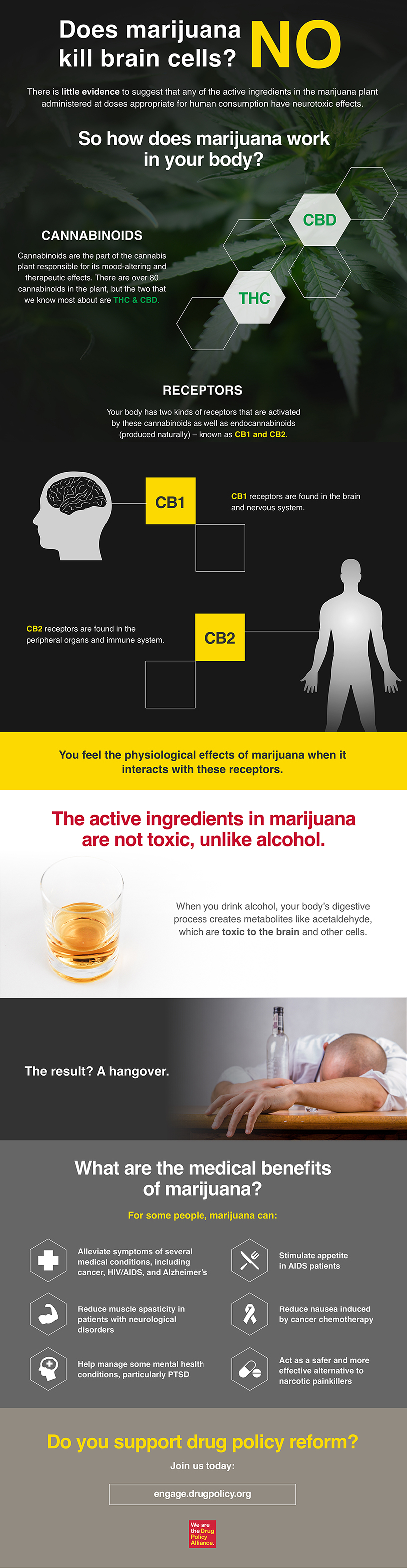
In terms of marijuana and its effects on brain cells, or neurons, there is little evidence to suggest that any of the active ingredients in the marijuana plant administered at doses appropriate for human consumption have neurotoxic effects.
This is in direct contrast to alcohol, where the body’s digestive process creates metabolites such as acetaldehyde and other “reactive oxygen species” which are toxic to the brain and other cells in the body. This is why you have a hangover, after drinking large quantities of alcohol.
The active ingredients in the marijuana plant, called phytocannabinoids, affect specific receptors within the body. In fact, the body produces its own set of cannabinoids called endocannabinoids and has an endocannabinoid system which regulates the activity of all cannabinoids in the body.
There are two types of receptors within the endocannabinoid system CB1 receptors and CB2 receptors. CB1 receptors are located primarily in the brain and nervous system, while CB2 receptors are located primarily in the immune system.
The fact that these receptors are located all over the body is part of the reason why marijuana has been found to be useful for so many different medical conditions.
Specifically in the case of seizures, there is preliminary research which shows that the cannabinoid, cannabidiol or CBD, raises the threshold for seizure activity within the brain making it overall more difficult to have seizures, and thus providing hope to many parents of children with intractable seizure disorders. There is also some preliminary research which show that other cannabinoids within the plant actually protect brain cells from damage associated with Alzheimer’s disease. However, much more research needs to be done in order to make definitive claims on the medical benefits.
The evidence at this point indicates that marijuana does more good than harm when it comes to its effects on the adult brain.
Infographic courtesy of: drugpolicy


marijuana lessons for canada usa vs portugal vs netherlands

Marijuana Lessons for Canada: Usa Vs Portugal Vs Netherlands #infographic

Many people are campaigning for marijuana legalization around the world. But from the legal point of view, what will that look like? Should people be allowed to smoke weed anywhere, or should there be certain restrictions? Can one grow weed at home? What falls under a criminal offence? Currently, Canada is faced with such questions. Their government has promised some sort of marijuana legalization, but it is still not clear what that will look like. With the purpose of contributing to the debate, this infographic compares marijuana legalization laws in three countries that can be used as a model: the USA, Netherlands and Portugal.

This analysis will, without a doubt, be interesting to non-Canadians as well, because it shows different approaches that these countries have to marijuana legalization. While some countries allow consuming a personal amount of this substance, others view it as an addiction issue. Again, growing weed at home is not without limitations. There are restrictions on the number of plants that can be grown and how they are looked after. All this shows that we are still far from a perfect legal model. Maybe Canada will lead in this process. In any case, when you read the following infographic, you will certainly look at the marijuana issue with different eyes.
Infographic courtesy of: omqlaw.ca


weedd

Recreational Dispensaries Could Finally Be Opening Shop in Massachusetts

Massachusetts voters legalized adult recreational cannabis via a ballot initiative vote in November of 2016. The state had already taken steps back in 2008 to decriminalize small amounts of cannabis for personal use. As of December of 2016, though adults in the state of Massachusetts possessing less than 1 oz of cannabis in public or 10 oz of cannabis in their home we’re officially abiding by the law.
The initiative in which voters passed in 2016 also allowed for the creation of cannabis dispensaries to serve the needs of adult consumers in the state. To date, however, none have opened. This could change however in the coming days.

It’s Been a Long Road but Dispensaries Could Open Soon

Like with every other state that has chosen to legalize cannabis it has taken time to do so. It has taken time for businesses to obtain all the approvals that are required for them to open shop. Entrepreneurs looking to open dispensaries in the state of Massachusetts don’t just have to obtain licensing and approval by the state. They also have to come to an agreement with their local governments before the state will review their applications.
As of September 6th, there were over 2,500 pending applications for various types of cannabis businesses hoping to open their doors to the new commercial market in the state. On September 20th there will be a Cannabis Control Commission hearing in which the first licenses may be approved.
On this date, the commission, which is the state’s cannabis authority, will review the applications of businesses that have passed certain aspects. Aspects such as physical site inspections as well as staff fingerprinting. If businesses that have passed these aspects receive approval on Sept. 20th, they could technically open their doors the next day. That is if they have met all other requirements including submitting their business license fee.
If no businesses receive approval during this meeting of the Cannabis Control Commission, the next hopeful date will be Oct 4th.

What is Legal for Cannabis Consumers in Massachusetts?

We know that Massachusetts has legalized cannabis and that dispensaries may soon open their doors, but what is and isn’t legal? Here is a breakdown of what is and isn’t allowed for adult cannabis consumers in the state. This is based upon the text of the approved ballot initiative passed in 2016.

What can be purchased and by who?

Adults over the age of 21 are allowed to purchase 1 ounce of cannabis. Alternately they can chose 5 grams of cannabis concentrates, or an equivalent combination of the two. This is the limit per day from licensed and state-regulated recreational cannabis dispensaries. Adults over the age of 21 will not be permitted to enter a medical cannabis dispensary without proof of a medical marijuana card upon entry.

How much cannabis can be legally possessed by adults over the age of 21 in the state?

Adults are able to legally travel with up to 1 ounce of cannabis in flower form, 5 grams of cannabis concentrates, or equivalence of the two within the state as long as it is not visible in the vehicle. In the privacy of their own homes, adults can possess up to 10 ounces of cannabis (or more) if the crop is from plants they cultivated at the residence.

Can adults obtain cannabis from friends legally?

Yes, as long as no money or services are provided in return.

Are adult consumers allowed to grow their own stash?

Yes. The initiative passed by voters allow for adults to grow up to 6 cannabis plants per adult residing at the residence. There is, however, a cap of 12 plants per household.

Where will dispensaries be located?

According to most reports, we can expect to see recreational dispensaries open in the following cities; Leicester, Northampton, Easthampton, Amesbury, Brookline, Salem, Fall River, Wareham, Plymouth, Lowell, and Greenfield. It is expected that a few others may receive approval in outlying areas as well.

Where can cannabis be consumed legally in the state?

Cannabis, unlike harmful and deadly cigarettes, can only be consumed in a few places. Parks and public areas are out of the question along with smoking in your car. If you live in the state or are visiting, you can legally consume in a private residence. That is if the home is owned by the occupants or consumption is approved by the landlord. Cannabis will also be able to be consumed at some private clubs and in some rental properties. Consumption on properties such as AirBnBs and hotels will be up to the owner/operators discretion.

Can cannabis that is legally purchased at a dispensary be taken out of state?

Absolutely not. Despite that it was legally obtained, any cannabis found in possession of someone outside of the state will still subject said individuals to the laws in the state in which they are found in possession of the product.
While it may have taken the state nearly 2 years, it is very exciting to see that we could be just a few short days away from seeing Massachusetts make history. And by making history, I mean by opening the doors to the states very first recreational cannabis dispensaries!

 

cand

Border Tensions: Canadians Could be Denied Access to the US for Cannabis Ties

While Canada has always been more liberal when it comes to their laws surrounding cannabis their upcoming legalization of retail adult use cannabis could start to cause some real issues at the border. In a recent statement to the news site known as Politico a senior US border official stated that “Canadians that are working or invested within the Cannabis sector could be denied entry into the US.” In fact, they could be “deemed inadmissible” banning them from crossing the border into the United States forever.

Just Another Outdated Tactic Holding on to Prohibition

In less than a month Canada is set to become the very first industrialized nation to legalize the recreational possession, cultivation, and consumption of cannabis by adults throughout their country. In the United States just south of Canada the federal government has not budged on their nearly century-old stance towards the very beneficial and nearly harmless plant. This is even though over half of the states in the United States have actually implemented comprehensive medical cannabis programs in more than a handful of states have also decided to allow adults the choice of a safer recreational alternative.
The current Canadian policy according to the Executive Assistant Commissioner for the Office of Field Operations Todd Owen “border officials on the Canadian US border are permitted to question Canadians about their cannabis use and association to the industry if they have a cause to do so.” He went on to state that “officers are not going to be asking everyone whether they have used marijuana but if other questions lay there or if there is a smell coming from the car they might ask.”

Something Legal Shouldn’t Ban You From a Country

It’s not just individuals that work within the Cannabis sector that need to worry about whether or not they will be able to enter the United States it is also those who are honest about their cannabis consumption. Despite the fact that you are a Canadian Living in Canada after the legalization of recreational Cannabis takes place if you admit to Canadian border officials that you consume cannabis legally in the country they have the right to deny you access from crossing the border into the lower 48.
In a report by the BBC which reached out to the US Customs and Border Protection Agency the CBP did validate that “working in or facilitating the proliferation of the legal marijuana industry in US states where it’s deemed legal or in Canada may affect a foreign national’s admissibility to the United States” solidifying that those working in the Cannabis sector although they are working legally could be denied access into the United States. This is simply ridiculous.

The Policy Most Likely Won’t Cause Many Issues

For many, however, this policy will most likely cause no issues as there are approximately 400,000 individuals that crossover between the two countries each day without incident even though it is widely known that a large percentage of Canadians enjoy utilizing cannabis for recreational or medical purposes. If you are a significant player in the sector however or are highly invested in the industry, you could encounter some issues just because people know that you are associated with the industry.

It Already Has Though for Some

Take for example a Vancouver businessman that was banned from crossing the border into the United States back in July only because he had made investments in US cannabis companies. He was not just banned from entering that day he was banned from entering the country for life. This is not the only case where individuals have been turned away and denied entry to the country. In fact, immigration lawyers have stated that they have heard similar accounts from clients throughout the industry.

Just Smoke a Joint Already

It’s sad that either country would waste precious resources on prohibiting cannabis professionals from moving freely between the two countries if they are not committing any crimes or participating in illegal operations. It would be like saying someone who works in a brewery in Canada couldn’t enter the United States because some states don’t allow for breweries. If you ask me everyone needs to get together and smoke a joint and get over the tensions that exist between the two countries when it comes to the topic of cannabis and embrace it once and for all.
Perhaps in the coming years, the United States will catch up to Canada, and the issue of cannabis will no longer be an issue on either side of the border.

coca colacbd

CBD-Infused Coca-Cola Could be a Thing

From CBD oils, CBD extracts, CBD capsules, and CBD topical lotions to CBD granola bars, CBD coffee, and CBD honey, it seems almost everything is being infused with this seemingly newly discovered compound. The most recent announcement pertaining to the CBD market came from none other than the Coca-Cola Company out of Atlanta, Georgia.
This U.S. based beverage manufacturer and distributor just hinted that they may be looking to merge into the CBD space and that a CBD-infused beverage from the makers of one of America’s most beloved drinks could be available in the near future. In a statement to Bloomberg via email, a spokesman for Coca-Cola, Kent Landers stated the following;
“We are closely watching the growth of non-psychoactive CBD as an ingredient in functional wellness beverages around the world. The space is evolving quickly.” Regarding whether they will enter the market, he stated, “no decisions have been made at this time.”

Why CBD?

So why would a company such as the Coca-Cola company that has been in business since 1892 all of a sudden be interested in branching into a new beverage market? The answer is simple. The CBD market is predicted to be worth more than $22 billion by 2020. That is a lot of money even for a beverage manufacturer of Coca-Cola’s size.
The movement to re-legalize cannabis around the world has become more successful in recent years. The research surrounding this miraculous plant has also become more abundant. What many believe to be one of the most significant discoveries is surprisingly not based upon one of the most researched compounds found in the plant. The most significant development regarding cannabis that many consider to be the medical breakthrough of the century is the discovery of and isolation of the cannabinoid known as Cannabidiol AKA CBD.
This naturally occurring phytocannabinoid is found in many cultivars of hemp as well as many different strains of the psychoactive form of cannabis commonly known as marijuana. CBD, unlike the more well-known phytocannabinoid THC, does not provide any psychoactive or intoxicating effects.
Very similar to THC, CBD has the potential to offer a plethora of different medical benefits. Benefits to patients suffering from a variety of different ailments. Not only does CBD provide potential medical benefits it has also been scientifically proven to combat the psychoactive effects of THC. CBD has been shown to be effective in helping to treat a wide range of conditions. Conditions ranging from anxiety and depression to pain, inflammation, nicotine addiction, skin disorders, epilepsy and many more.

CBD-Beverages – The “In” Trend

Coca-Cola isn’t the first beverage company that has hinted at entering the CBD market either. In fact, several already have. Constellation Brands, the parent company of the popular brew Corona announced that they were spending nearly $4 billion to up its stakes in a Canadian cannabis producer known as Canopy Growth. Canopy Growth is estimated to worth more than $10 billion.
Other beverage makers that have entered into the sector include Molson Coors which has entered into a joint venture with Hexo’s Corp. Hexo’s Corp was formerly known as the Hydropothecary Corp and is based out of Quebec. They plan to work together to produce cannabis-infused beverages for the Canadian market.
Anheuser Busch, the manufacturer of Budweiser beer, has also mentioned a potential CBD-infused beverage line. This is in addition to Diageo PLC, the maker of Guinness which is currently in discussions with multiple Canadian cannabis producers. We can’t forget to mention the craft-brewing label known as NV’s Lagunita’s a Heineken company. This company took it up a notch and  has already launched a brand that specializes in THC infused non-alcoholic beverages.

So, What’s Next?

Since this announcement from the Coca-Cola Co. stocks in a few different Canadian cannabis producers have seen an increase in interest. Shares in Aurora Cannabis rose as much as 23% after the announcement to over $8 a share. Tilray Inc. also nearly a 9.5% increase as well.
When it comes to the question of whether a CBD-infused Coca-Cola offering could be available soon, the answer is simple. We simply must wait. What we do know is that they are paying close attention. It is on their radar, and it wouldn’t be surprising if it weren’t a Coca-Cola at all as the company has also recently ventured into other beverage options such as tea and juice in recent years. They also recently spent $5.1 billion to acquire Costa Coffee earlier this year.
Considering the potential growth for this market in coming years, it would seem natural that the Coca-Cola Co. and every other major player in the beverage market would want to take advantage of this opportunity. Only time will tell if they will.

tlc

The Boiling Point of Cannabis’ Complexity

THC or Delta-9-Tetrahydrocannabinol is a cannabinoid that many are familiar with since this has been the primary focus of conversations and research pertaining to cannabis for years. In recent times, however, we have started to discover that what makes cannabis so incredible isn’t just this one cannabinoid. In fact, it isn’t even the many combinations of different cannabinoids that are possible but in reality, something much more complex.
The reason that cannabis is as effective as it is for a plethora of different ailments and offers such a wide range of benefits, flavors, and aromas, is due to a combination of cannabinoids, terpenes, flavonoids, and other compounds found in the cannabis plant. Simply lighting a joint of a random strain of cannabis, however, will not provide the full effects possible.

What You Need to Know About Getting the Most Out of Your Herb

Terpenes matter as much as cannabinoids. This cannot be expressed enough. Terpenes which are also found in fruits, vegetables, and other plants are essential to the overall effects of cannabis. Terpenes also provide a plethora of different health benefits as well. Therefore, many cannabis consumers and patients alike have started to pay more attention to the terpene profiles present in the products they purchase.
Here are some of the common terpenes found in cannabis strains along with their potential medical benefits. While this is nowhere near a comprehensive list as there are over 125 terpenes found in cannabis, these are the most common and abundant.

  • ß-myrcene: Analgesic. Anti-inflammatory, Antibiotic, Antimutagenic
  • ß-caryophyllene: Anti-inflammatory, Cytoprotective (gastric mucosa), Antimalarial
  • d-limonene: Cannabinoid agonist, Immune potentiator, Antidepressant, Antimutagenic
  • linalool: Sedative, Antidepressant, Anxiolytic, Immune potentiator
  • pulegone: Memory booster, AChE inhibitor, Sedative, Antipyretic
  • 1,8-cineole (eucalyptol): AChE inhibitor, Increases cerebral, blood flow, Stimulant, Antibiotic, Antiviral, Anti-inflammatory, Antinociceptive
  • a-pinene: Anti-inflammatory, Bronchodilator, Stimulant, Antibiotic, Antineoplastic, AChE inhibitor
  • a-terpineol: Sedative, Antibiotic, AChE inhibitor, Antioxidant, Antimalarial
  • terpineol-4-ol: AChE inhibitor. Antibiotic
  • p-cymene: Antibiotic, Anticandidal, AChE inhibitor

Unfortunately, while many of these terpenes are present in various cannabis strains, their benefits are often abolished through a process known as pyrolytic destruction. This process is where terpenes are heated to a higher temperature than their boiling point therefore essentially eliminating them from existence. The same thing occurs when cannabinoids are heated beyond their boiling points. Here are the boiling points for the most common cannabinoids and terpenes found in cannabis.

Common Cannabinoid Boiling Points

  • Delta-9-tetrahydrocannabinol (THC): 157˚C / 315˚F
  • Cannabidiol (CBD): 160-180˚C / 320-356˚F
  • Cannabinol (CBN): 185˚C / 365˚F
  • Cannabichromene (CBC): 220˚C / 428˚F
  • Cannabigerol (CBG): 220˚C/428˚F
  • Delta-8-tetrahydrocannabinol (Delta-8-THC): 175-178˚C / 347-352.4˚F
  • Tetrahydrocannabivarin (THCV): < 220˚C / <428˚F

Common Terpene Boiling Points

  • ß-myrcene: 166-168˚C / 330.8-334.4˚F
  • ß-caryophyllene: 119˚C / 246.2˚F
  • d-limonene: 177˚C / 350.6˚F
  • linalool: 198˚C / 388.4˚F
  • pulegone: 224˚C / 435.2˚F
  • 1,8-cineole (eucalyptol): 176˚C / 348.8˚F
  • a-pinene: 156˚C / 312.8˚F
  • a-terpineol: 217-218˚C / 422.6-424.4˚F
  • terpineol-4-ol: 209˚C / 408.2˚F
  • p-cymene: 177˚C / 350.6˚F

Pyrolytic Destruction – Ruining Your Cannabis One Boiling Point at a Time

As you can see, the boiling points of various terpenes and cannabinoids drastically vary. To avoid pyrolytic destruction many consumers and patients have turned to vaporizing cannabis products. This is because vaporizing eliminates the combustion required for smoking dry herb. Vaporizers, however, tend to heat to specific degrees only; therefore only a portion of the terpenes and cannabinoids are absorbed by the consumer.
While vaporizing would allow a consumer to pinpoint and consume products at a certain temperature allowing them to better tailor their consumption towards the effects they are after, in the process the boiling points of many other terpenes and cannabinoids are not reached or are surpassed. So essentially vaporizing still does not allow consumers and patients to truly experience the full potential of the effects of different cannabis products.

A Complete Cannabis Consumption Experience

One company, however, is aiming to change that. NWT Holdings, the parent company of Firefly vaporizers, has introduced a new vaporizer product that utilizes dynamic convection heating. This process of heating cannabis products is different than what is utilized by other vaporizers on the market today.
Dynamic convection heating gradually heats the chamber around your cannabis across an extensive temperature range. This allows the consumer to benefit from each individual terpene and cannabinoid being heated to their exact boiling point over the course of a 7 second inhale.
This is incredible for both consumers and patients alike. In fact, this could revolutionize the way that we consume cannabis. Never has anyone been able to truly experience the full potential of cannabis but now thanks to innovative leaders and products such as the new line from Firefly featuring dynamic convection heating, we can. This will not only enhance the benefits that we receive as consumers but will also allow us to learn more about the many cannabis strains available on the market today.
 

seeing green reaping the benefits of regulated marijuana

Seeing Green Reaping The Benefits Of Regulated Marijuana #Infographic

The topic of marijuana legalization is nothing new, but the conversation has shifted in recent years, as laws relax in various states throughout the U.S.
Taking a more journalistic approach to join the conversation, the folks at Digit sought to examine shifting public opinion, new taxation policies, and how global economies function under legal marijuana status.
Infographic courtesy of: digit.co

weed

Infusing Yoga with Cannabis – What You Need to Know

Despite cannabis just becoming “legal” in many places, it’s existence dates back more than 10,000 years. Before prohibition began just less than a century ago and still today, cannabis is utilized for many different reasons in a plethora of cultures globally. One of those reasons is for spiritual purposes and enlightenment.
Another ancient practice that is believed to be one component of an overall enlightened lifestyle is yoga. In the publication titled “Yoga Sutras” which was penned roughly 2,000 years ago by an Indian Sage named Patanjali there are references to the utilization of herbs as one of the 5 paths to enlightenment.
Many believe these references are about cannabis. This is due to the history of cannabis in the Indian culture. For example, in India, it’s tradition to honor the deity Shiva with cannabis elixir. India has also referenced cannabis sativa in texts from the Vedic period regarding an intoxicating ritual drink known as Soma.
Today many individuals are choosing to combine the two ancient components in what the masses refer to as Ganja Yoga. Cannabis-infused yoga if you will is, in fact, becoming quite the hit in cities around the world as the movement to legalize the herb once more continues to be victorious.

The Synchronicity of Combining the Cannabis and Yoga

Many people are familiar with the benefits of Yoga and the benefits of cannabis, but are the two better together? According to individuals such as Lu Pancini, a certified yoga instructor that runs The House of Yoga where yogis and consumers can partake in cannabis-infused yoga sessions, and her husband Joey, cannabis could be the key to allowing individuals the ability to “enjoy the full benefits of yoga.”
Here are some of the benefits of combining cannabis and yoga!

  • Cannabis relaxes both the mind and body which in return will allow you to become more mindful and eliminate pain points.
  • Cannabis helps to relieve both pain and anxiety. These are two factors that could otherwise reduce the effectiveness of yoga.
  • It is believed that cannabis consumption even in small doses before a yoga session can help students to become more in-tune with the philosophy that the body, mind, and spirit are one, an essential philosophy of yoga.
  • Cannabis for many also lowers inhibitions allowing students to try poses they may not have tried previously.
  • The practice of yoga tends to help reduce stress and decrease blood pressure. It can also increase metabolism and support your overall immune system. Coincidentally, cannabis can also help with all of these aspects, so it only makes sense that the two would work even better together.

From Ancient Text to Modern Times

One of the earliest texts of spiritual guidance known to man as The Vedas references the use of yoga and cannabis together dating back as far as 2000-1400 BC. The first U.S. pairing of the two in the modern day, however, was in 2009, and the two were brought together by Dee Dussault.
Dee has more than 20 years of experience as a hatha yoga instructor. She is also the author of Ganja Yoga: A Practical Guide to Conscious Relaxation, Soothing Pain Relief, and Enlightened Self-Discovery. This publication provides guidance on how to best incorporate cannabis into your yoga routine.
Speaking of how to incorporate the herb into your yoga practices best, here are a few tips for combining the two for the most elevated and enlightened experience possible.

Tips for Incorporating Cannabis into Your Yoga Routine

When it comes to incorporating cannabis into your yoga routine, there are a few things you will want to remember. One is you know your body better than anyone, and you know what works and what doesn’t. Never deny your self-knowledge. Consume and proceed only as you feel comfortable. It is only then that you will truly be at one and benefit the most from this experience. With this in mind, here are a few other tips for combining cannabis and yoga.

  • Start your routine with a Sativa strain or a Sativa dominant hybrid. These types of strains tend to provide an energetic and uplifting effect. If Sativas are known for making your mind race or increasing your anxiety, it may be best to start with a hybrid. You know your body best. Find what works for you and go with the flow.
  • Indica strains are recommended towards the end and even after your routine as they relax the body and mind. This allows you to remain in a state where you can best reflect on your practices.
  • Ganja yoga isn’t just about smoking cannabis either. In fact, many people who combine the two actually prefer to utilize different consumption methods. Methods such as consuming edibles, infused drinks, and vaping as opposed to or even in combination with smoking.

Do you incorporate cannabis into your yoga routine or have you ever attended a Ganja Yoga type class? If so, we’d love to hear your thoughts and suggestions in the comments below!

Untitled

Smoking Vs. Vaporizing…What's the Difference?

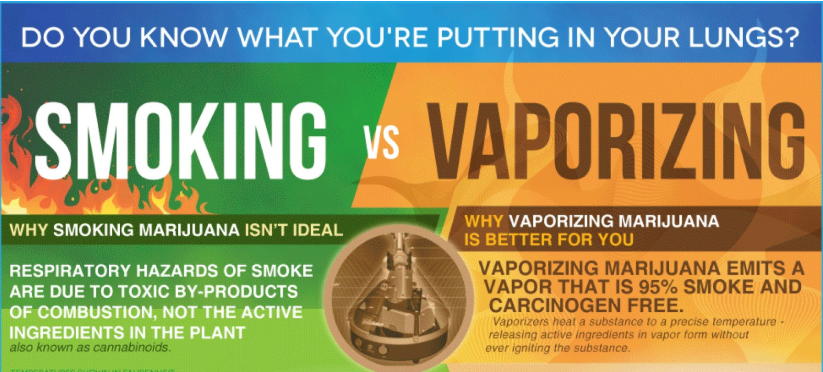
Smoking marijuana Vs. Vaporizing marijuana: Depending on one’s experience within the realm of cannabis consumption, some may never have heard of vaporizing.
Vaporizing marijuana is a common technique for consuming marijuana, while at the same time negating many irritating respiratory toxins that exists within the grown marijuana flower and are released when smoked. Conversely, vaporizing cannabis allows one to get at all of the psychoactive ingredients available within that specific strain of marijuana , minus the combustion that ordinarily takes place during consumption.
The basic design of the average marijuana vaporizer is to allow marijuana smokers to inhale the many active Cannabinoids, while at the same time avoiding any of the harmful elements that may exist on that specific flower… although invisible to the naked eye.
While most don’t know it … There is a vast difference in the quality of smoke that one receives when they are vaporizing marijuana vs smoking marijuana. When one smokes a joint, or hits their bong approximately 88% of the combusted smoke gases contain non-cannabinoid elements, most of which do not get you high and provide potential health risks.
Conversely when one is vaporizing marijuana the gases that they are inhaling consists of approximately 95% cannabinoids, otherwise known as the psychoactive ingredients that both calm the mind and soothe the body.


Sources: Themaven and Marijuana.