
Is Legalization Really Responsible for More Car Crashes

Is Legalization to Blame for the Increasing Number of Car Related Fatalities?

opioid treatment

Colorado State and Federal data shows a rise in the number of drivers involved in fatal crashes who tested positive for marijuana.The overall number has doubled since marijuana legalization in 2013. The Denver Post recently launched an in-depth investigation into this issue. They are (among other things) reading coroner’s reports to determine if Colorado’s roads have become unsafe since legalization. In Front Range counties, more drivers involved in fatal car accidents are testing positive for marijuana than before 2013.

Part of what people fear is negligent drivers behind the wheel. In 2016, nearly a dozen drivers tested positive for THC with almost five times the legal amount in their systems. In 2016, a report from the National Highway Traffic Safety Administration’s (NHTSA) Fatality Analysis Reporting System showed some surprising information about drivers.

It’s just plain difficult to accurately test cannabis intoxication.drivers

Drivers who survived car crashes were regularly drug tested within a few hours of the incident. This type of information is trying to show how recently drivers consumed cannabis.The problem they run into is that cannabis metabolizes slowly.

Although the high wears off after a few hours, THC remains in a persons system for up to 30 days. Especially heavy or sedentary people may find that THC remains in their system for significantly longer than that. A person could have been high days before but still test positive after an accident. This makes it look like they were high while driving when in fact, they weren’t.

According to the Denver Post, “positive test results reflected in the NHTSA data do not indicate whether a driver was high at the time of the crash since traces of marijuana use from weeks earlier also can appear as a positive result”. Nevertheless, there is a clear trend of car accidents with marijuana in the driver’s system. This trend is causing great concern with city officials and residents. Without an in-depth investigation into the specifics, everyone is left wondering if legalization is to blame.

There are studies on drivers, accidents and cannabis.

Other studies show that in 2013, 10% of drivers who were involved in fatal car accidents tested positive for marijuana. By 2016, that figure rose to 20%. Also, more drivers are testing positive for cannabis and nothing else. Slightly more than 52% of drivers had no alcohol in their system in 2013 and by 2016 that figure rose to 69%.

Of the 115 drivers involved in fatal accidents in 2016 alone, 71% had THC in their systems. Of those approximately 81 people, 63% had over 5 nanograms of THC (the legal limit) floating around in their veins. The average age of drivers in fatal accidents was between 35 and 40 years of age.

Taylor West is the former deputy director of the National Cannabis Industry Association. According to Taylor, “Unlike alcohol, THC can remain detectable in the blood stream for days or weeks. When any impairment wears off in a matter of hours. So, these numbers really tell us is that, since legal adult-use sales began, a larger number of people are consuming cannabis. And then at some point… (are) driving a car.”

Survivors and victims need something to fight.

Ed Wood of DUID (Driving Under the Influence of Drugs) Victim Voices, started this organization after his son’s death. He believes his son’s death was the direct result of a drugged driver. Ed feels like the system only cares about tax revenue from marijuana and not the people he feels it affects. Instead of simply complain about a system he disagrees with, he activated and found other like-minded people.

Ed Wood and other families who have lost loved ones in a fatal car accidents are compelled to seek closure. If someone can say that the driver was intoxicated, it becomes a rallying cry to purge society of that substance. Mothers Against Drink Driving (MADD), Mothers Against Prescription Drug Abuse (MAPDA) and more are reactions to the very real issue of unsafe roads. But they lead into the next issue.

The system is set up against cannabis users.

People often claim that it is too early to tell whether marijuana is the true culprit for the rising number of fatalities. And that additional data is required before any real conclusions can be done.But that is where things get sticky. You see, it’s incredibly difficult to research marijuana.

Only two universities nationwide are allowed, by the government, to conduct research on how marijuana affects the human body. But they have to get permission from the Department of Justice (DOJ) before they can start any studies. The DOJ has made it clear that they have no intention of permitting marijuana research as long as Jeff Sessions remains Attorney General.

This means that law enforcement is left with no solid way to prove that drivers are dangerous when under the influence of THC. The executive director of the Colorado-based Marijuana Industry Group (Kelly) says, “There needs to be better understanding about what constitutes impairment”. And cannabis users should want a reliable way to test for impairment.

Washington and Colorado are undergoing similar driver trends.CBD Flower 1
Since Washington’s legalization, the rise of fatal car accidents involving cannabis has risen. But the problem still remains, that there is no definitive method of testing drivers for recent use of cannabis. Yes, drivers are found with cannabis in their system, but the tests don’t show is if they were impaired while they were driving. This means that dangerous drivers hide behind innocuous drivers and cause unnecessary complications and loss of life.

Washington States policy for DUI is that they test for alcohol first. Once a driver is found with alcohol that is over the limit, they don’t bother testing for marijuana. According to Washington police, they don’t have the time and resources to do a thorough check of alcohol and marijuana. According to Denver’s coroner’s report, people are f
ound with higher levels of THC on average than before. Their toxicology tests are showing THC levels as high as 24 ng/ml; with one result showing 68 ng/ml.

Police Chief Jackson says that potency is the issue here.

That the weed of today is not the same weed that was consumed during our grandfather’s time. The levels of acute overdose is what he believes is causing the number of accidents to increase.Although there is no peer-reviewed scientific evidence supporting his claim.

Coroners disagree on whether the presence of THC should be listed on a death certificate. This is because of how people interpret as impairment. Jill Romann, Douglas County’s coroner says, “There are others across the state who feel the same way and won’t use the word intoxication with it. Despite the fact we are all coroners, everyone does as they want.”

Hopefully the Denver Post can shed some light on how cannabis users drive. It is always good to remember that correlation is not the same as causation. Just because people buy more ice cream on hot days doesn’t mean that buying ice cream makes the day hotter. Likewise, just because more people have THC in their system doesn’t mean THC is causing accidents. But scientists have to look at all the data, even the stuff that doesn’t agree with our preconceived notions.
How do you feel about driving while high? Do you think DUID, MADD or MAPDA are on crazy? Have you lost someone to an intoxicated driver and how did that change your view? Let us know in the comments below and what you think should be done.

weed drive

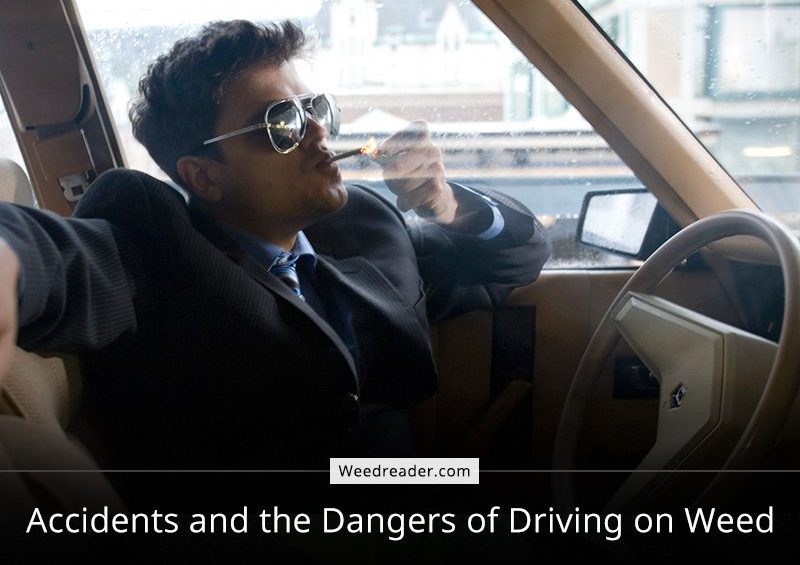
Accidents and the Dangers of Driving on Weed

Most people have been taught that alcohol increases the risk of accidents.

Smoking and driving can get you a DUI for an accident even in states where cannabis is legal. Current state laws for marijuana have focused on regulating it like alcohol while on the road. This is especially true when it comes to consuming and driving. Yet evidence of marijuana’s culpability in on-road accidents is difficult to prove.
Many states have reduced penalties for cannabis related crimes over the last few years. Yet as states continue to loosen regulations on marijuana safety, law enforcement is struggling to figure out how to establish a legal limit for drivers. They have focused on setting a blood-content test just like the .08 limit for alcohol.
A new study shows the challenges in accurately testing drivers.
One of the most difficult parts of testing is developing a threshold for what’s considered too high to drive. The conductors of the study concluded that “THC concentrations drop rapidly during the time required to collect a blood specimen in the U.S., generally within two to four hours.”
The low amount of time cannabis remains active for oral tests using the drivers’ saliva make it harder to fail than traditional tests. Saliva tests can be done roadside without a long wait but researchers found oral tests don’t provide “a precise measure of the level of impairment.”
Politicians are hesitant to implement concentration-based cannabis-driving legislation because it might ” unfairly target individuals not acutely intoxicated, because residual THC can be detected in blood for up to a month of sustained abstinence in chronic frequent smokers.” Depending on the direction that the new Attorney General Jeff Sessions takes the Justice Department over the coming years, detecting residual cannabinoids may be more important than registering intoxication.

Smoking weed is not safe while driving.

Cannabis intoxication has been shown to mildly impair a drivers psychomotor skills. It doesn’t appear to be severe or long lasting though. In driving simulator tests, this impairment was typically manifested by decreasing driving speed and needing more time to respond to emergency situations.
Yet this impairment does not appear to play a significant role in on-road traffic accidents. A review of seven different studies involving 7,934 drivers showed in 2002, “Crash culpability studies have failed to demonstrate that drivers with cannabinoids in the blood are significantly more likely than drug-free drivers to be culpable in road crashes.” And it’s not like people haven’t tried to prove a link either.
A Massive body of research exists that explores the impact of marijuana on psychomotor skills and actual driving performance. Researchers have done driving simulator studies, on-road performance studies, crash culpability studies, and reviews of the existing evidence. To date, the result of this research has shown how mildly cannabis affects driving abilities but that won’t stop the cops from hauling you off for having it in your system if you get in an accident.

Bad accidents

Marijuana has a measurable yet relatively mild effect on psychomotor skills.

Yet it does not appear to play a significant role in vehicle crashes, particularly when compared to alcohol. Researchers conducting a study for the National Institute on Drug Abuse said alcohol “significantly increased lane departures/minimum and maximum lateral acceleration”. Cannabis did not have the same correlation between consumption and decreased performance.

Researchers for the Highway Traffic Safety Administration funded study concluded Cannabis-influenced drivers are better able to measure their intoxication “may attempt to drive more cautiously to compensate for impairing effects, whereas alcohol-influenced drivers often underestimate their impairment and take more risk.”

People keep studying the link between cannabis, alcohol and car accidents.

The prevalence of both alcohol and cannabis use and the extreme morbidity associated with car crashes has lead to repeated research on the link between the two. According to another study, “drunk drivers are involved in 25% of motor vehicle fatalities, and many accidents involve drivers who test positive for cannabis.”
The researchers say that while both alcohol and cannabis impair performance in a “dose-related fashion” the “effects of cannabis vary more between individuals than they do with alcohol because of tolerance, differences in smoking technique, and different absorptions of Δ9-tetrahydrocannabinol (THC), the active ingredient in marijuana.”
The effects of a cannabis “high” vary according to dose but are more pronounced with highly automatic driving functions than with more complex tasks.” Basically making it easier to focus on a plan than instinctively react to something. With alcohol the opposite pattern of impairment is produced and people get distracted easier.

Cannabis and alcohol have a synergistic effect.

Because of an increased awareness that they are impaired, “marijuana smokers tend to compensate more effectively while driving than drunks” by utilizing a variety of strategies. Mixing marijuana with alcohol removes the ability to use such strategies as the two substances increase the potency of the other when mixed.
Cannabis and alcohol work on many of the same levels in the brain and both inherently affect chemical production in the brain. Mixing cannabis and booze will amplify the effects of both and can lead to serious repercussions. While studies have been inconclusive regarding whether cannabis use causes an increased risk of accidents; in contrast, unanimity exists that alcohol use increases the risk of crashes.
In addition, the risk from driving under the influence of alcohol and cannabis together is higher than the risk of driving under the influence of either alone. One study even recommends that patients who smoke cannabis wait several hours before driving, and avoid combining the two drugs.

Even schools have studied how dangerous driving while high is.

The first study to analyze the effects of cannabis on driving was conducted by Researchers at the University of Iowa’s National Advanced Driving Simulator, sponsored by National Highway Traffic Safety Administration, National Institute of Drug Abuse, and the Office of National Drug Control Policy.
The researchers found that cannabis use caused almost no impairment. The impairment that it did cause was similar to the change observed while under the influence of a legal alcohol limit. They basically couldn’t get cannabis to impair driving as much as one beer.
They tested impairment mainly with a simulator. “Once in the simulator—a 1996 Malibu sedan mounted in a 24-feet diameter dome—the drivers were assessed on weaving within the lane, how often the car left the lane, and the speed of the weaving. Drivers with only alcohol in their systems showed impairment in all three areas while those strictly under the influence of vaporized cannabis only demonstrated problems weaving within the lane.”

More research is needed to find the right limits.

All these study’s findings show that alcohol is a much more dangerous drug than cannabis yet regulated in a more relaxed manner. While driving while under the influence of cannabis can still get you locked up, it is unclear how dangerous it is. More research is needed to show exactly how much cannabis should be legally allowable but for the time being, driving after consuming any cannabis remains illegal.
Until the whole world switches over to autonomous vehicles and we don’t have to worry about driver error any more, people are still going to get into accidents (sober or not). It is best not to contribute to the problem and simply don’t drive while high. You never know when you might need to instinctually react to something in your lane. Thanks for reading.